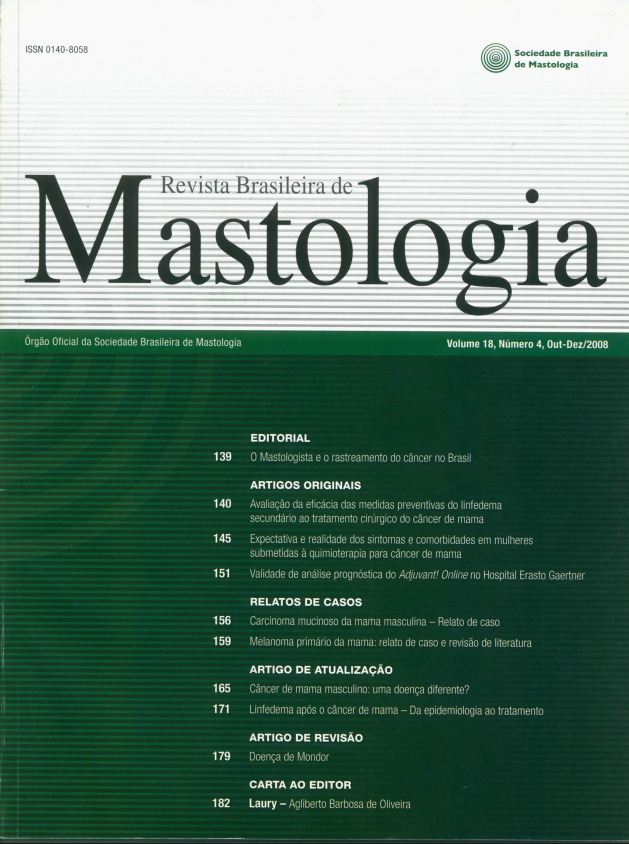
Validade de análise prognóstica do Adjuvant! Online no Hospital Erasto Gaertner
Palavras-chave:
Neoplasias da mama, Quimioterapia adjuvante, Prognóstico, Estudos de validação, Validação de software, MortalidadeResumo
Adjuvant! é um programa de computador mundialmente utilizado por oncologistas na decisão
da adjuvância do câncer de mama precoce, porém apenas foi testado e validado na população
norte-americana e britânica, não tendo nunca antes sido testado em populaçóes de países menos
desenvolvidos. Métodos: Selecionaram-se 181 pacientes com câncer de mama estádios I e II tratadas há mais de 10 anos e aplicaram-se as variáveis do programa para previsão da mortalidade
global, mortalidade específica por câncer, sobrevida livre de doença e probabilidade de recidiva
em 10 anos. Comparou-se a média de todas as pacientes com o resultado observado. Resultados:
A maior diferença entre os valores previstos e observados foi de 6,4% no cálculo da mortalidade
pelo câncer. Quanto à mortalidade global, a diferença foi de 4% e, em relação ao intervalo livre
de doença, 3,1%. Conclusão: Não se observou diferença estatística significante entre os valores,
demonstrando o programa ser uma boa ferramenta nesta instituição.
Downloads
Referências
1. ParkA. Breast-cancer basics. Diagnosis and treatment keep changing.
Here's what you need to know now. Time. 2007; 170(16):46-7.
2.
3.
Albain K, Green S, Ravdin P, Cobau C, Levine E, Ingle J, et al.
Overall survival after cyclophosphamide, adriamycin, 5FU and
tamoxifen is superior to tamoxifen alone in postmenopausal, rеceptor (+), node (+) breast cancer: new findings from phase III
Southwest Oncology Group Intergroup trial $8814 (INT-0100)
(abstract). Proc Am Soc Clin Oncol. 2001;20:24a.
Goldhirsch A, Gelber RD, Castiglione M. The magnitude of endocrine effects of adjuvant chemotherapy for premenopausal breast cancer patients. The International Breast Cancer Study Group.
Ann Oncol. 1990;1:183-88.
4. Colleoni M, Gelber S, Goldhirsch A, et al. Tamoxifen after adjuvant chemotherapy for premenopausal women with lymph nodepositive breast cancer: International Breast Cancer Study Group
Trial 13-93. J Clin Oncol. 2006;24:1332-41.
5. Goldhirsch A, Coates AS, Colleoni M, Castiglione-Gertsch M,
Gelber RD. Adjuvant chemoendocrine therapy in postmenopausal breast cancer: cyclophosphamide, methotrexate, and fluorouracil dose and schedule may make a difference. International Breast
Cancer Study Group.J Clin Oncol. 1998;16:1358-62.
6. Berry DA, Cronin KA, Plevritis SK, et al. Effect of screening and
adjuvant therapy on mortality from breast cancer. N Engl J Med. 2005;353:1784-92.
7. Luke C, Gill G, Birrell S, Humeniuk V, Borg M, Karapetis C, et
al. Treatment and survival from breast cancer: the experience of
patients at South Australian teaching hospitals between 1977 and
2003. J Eval Clin Pract. 2006;13(2):212-20.
8. Kenemans P. Quality of life in breast cancer patients. Gynecological Endocrinology: The Official Journal of the International
Society of Gynecological Endocrinology. Gynecol Endocrinol.
2007;23(7):366-7.
9. Habel LA, Shak S, Jacobs MK, et al. A population-based study of
tumor gene expression and risk of breast cancer death among lymph node-negative patients. Breast Cancer Res. 2006;8:R25.
10. Masood S. The knowledge about risk for breast cancer: the patients
right to know. Breast J. 2008;14(3):219-20.
11. Richards MA, O'Reilly SM, Howell A, et al. Adjuvant cyclophosphamide, methotrexate, and fluorouracil in patients with axillary
node-positive breast cancer: an update of the Guy's/Manchester
trial. J Clin Oncol. 1990;8:2032-39.
12. Fisher B, Dignam J, BryantJ, Wolmark N. Five versus more than five
years of tamoxifen for lymph node-negative breast cancer: updated
findings from the National Surgical Adjuvant Breast and Bowel Project B-14 randomized trial. J Natl Cancer Inst. 2001;93:684-90.
13. Paik S, Tang G, Shak S, et al. Gene expression and benefit of chemotherapy in women with node-negative, estrogen receptor-positive breast cancer. J Clin Oncol. 2006;24:3726-34.
14. Ravdin P, Simonoff LA, Davis GJ, et al. Computer program to
assist in making decisions about adjuvant therapy for women with
early breast cancer. J Clin Oncol. 2001;19(4):980-91.
15. Olivotto IA, Bajdik CD, Ravdin PM, et al. Population-based validation of the prognostic model ADJUVANT! for early breast cancer. J Clin Oncol. 2005;23:2716-25.
Downloads
Publicado
Como Citar
Edição
Seção
Licença
Copyright (c) 2026 Sérgio Bruno Bonatto Hatschbach, Leonardo Dequech Gavarrete, Thatiana Tiemi Ikeda, José Clemente Linhares, João Antônio Guerreiro, Claudiane Ligia Minari

Este trabalho está licenciado sob uma licença Creative Commons Attribution 4.0 International License.