Submissões
Condições para submissão
Como parte do processo de submissão, os autores são obrigados a verificar a conformidade da submissão em relação a todos os itens listados a seguir. As submissões que não estiverem de acordo com as normas serão devolvidas aos autores.Diretrizes para Autores
Introduction
Mastology is an international, multidisciplinary Journal, and the official publication of the Brazilian Society, is a specific medical journal established in 1991 to provide continuing medical education with a focus on breast diseases. The intentions are publishing articles on epidemiology, prevention, control, screening, biomarkers, diagnosis, therapeutics, rehabilitation, quality of life and scientific advances to improve the understanding of breast diseases and patient-related care.
All manuscripts will be initially accessed by the Editor for suitability for the Journal. Papers deemed suitable are then evaluated by at least two independent expert reviewers, in a blind-review process to assess the scientific quality of the paper. The Editor is responsible for the final decision regarding acceptance or rejection of articles. Those that do not have merit, which contain significant methodological errors, or that do not fit into the editorial policy of the Journal will be rejected and can not be appealed. The reviewers’ comments will be returned to the Authors for modifications in the text or justification of their conservation. Only after the final approval of the reviewers and Editors, will the manuscripts be forwarded for publication. All manuscripts accepted for publication shall become the property of the Journal and may not be edited, in whole or in part, by any other means of dissemination, without the prior written authorization issued by the Editor-in-Chief.
License Information
Mastology adopts Creative Commons Attribution 4.0 International Public License (CC-BY 4.0 license) for maximum dissemination and use of licensed materials. This one allows people to share and adapt the material if appropriate credit is given, a link to the license is provided, and an indication is given if changes were made. For more information access the link (https://creativecommons.org/licenses/by/4.0/).
Ethics
If the paper involves human subjects, the authors must ensure that the study complies with the Code of Ethics of the World Medical Association (Declaration of Helsinki) and the Uniform Requirements for Manuscripts Submitted to Biomedical Journals.
All animal experiments should follow the ARRIVE guidelines and be conducted according to the U.K. Animals (Scientific Procedures) Act (1986), EU Directive 2010/63/EU, or the NIH Guide for the Care and Use of Laboratory Animals (NIH Publications No. 8023, revised 1978).
Mastology does not accept editorial or scientific material for commercial or promotional purposes.
Ethical recommendations to be reported:
- The number and institution of the Ethics Committee approval must be clearly stated (for studies conducted in Brazil, include the CAAE number issued by Plataforma Brasi, number of the evaluation and date of approval).
- If ethical review is not required (e.g., meta-analysis, systematic review), the applicable regulation must be cited (Resolution 466/2012 for Brazilian studies, or equivalent national rule for others).
- Case reports require Ethics Committee approval.
- Ethical evaluation is generally required for original articles, short communications, and case reports.
- For images in Mastology, Ethics evaluation and patient authorization must be included in the submission documents.
Submission of Manuscripts
Manuscripts must be submitted exclusively through the electronic submission Schollarone Submission System available on the Mastology website at: https://www.mastology.org/submit-article/
Manuscripts may be submitted in Portuguese or English. Upon acceptance, all manuscripts will be translated into English by Mastology at no cost to the authors.
The corresponding author must ensure that all coauthors are correctly identified with full name, institutional affiliation, e-mail address, and ORCID.
During submission, the following files must be uploaded:
- Main manuscript (.doc or .docx);
- Main document - Tables (.doc or .docx);
- Figures (separate files in .tiff or .jpg, minimum resolution 300 dpi);
- Supplementary material for review (it applicable)
- Supplementary material not for review
Proof of ethical approval, when applicable
Single author declaration form (link to the document)
Another file with the author consider necessary
- Cover letter addressed to the Editor-in-Chief;
Manuscripts must not be under consideration by another journal nor previously published.
Incomplete submissions or those not in compliance with the Instructions for Authors may be returned before the editorial review process begins.
Accepted Manuscript Types
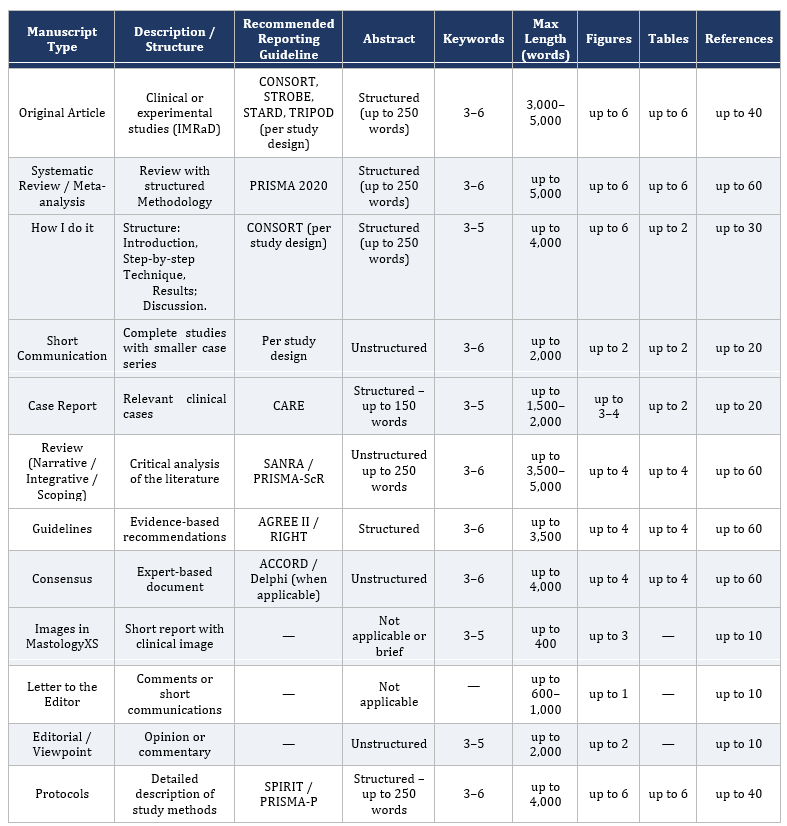
Mastology accepts the following categories of manuscripts. Recommended structure, number of words, tables, figures and references are shown in Table 1.
- Original Articles
- Short communications
- How I do it
- Review
- Guidelines
- Consensus
- Case Reports
- Images in Mastology
- Letters to the Editor
- Editorials / Viewpoints
- Protocols
Original Articles: Describe experimental or clinical research – prospective or retrospective, randomized or double-blind study, longitudual or transversal. Systematic reviews (with or without metanalysis must be considered as original articles.
Short Communications: Reports on important new results that fall within the scope of the journal may be submitted as short communications.
How I do it: Brief communications of authors' innovations in clinical or research techniques that simplify procedures or improve results are invited. Authors should briefly state the problem, describe the solution, and give a short summary of the results, where appropriate.
Review Articles: This reviews group narrative, scope or integrative reviews. New and systematic critical evaluation of the literature on a given subject, so as to contain a comparative analysis of the works in the area, which discusses the limits and methodological scope, allowing to indicate perspectives of continuity of studies in that line of research and should contain conclusions. The procedures adopted for the review, as well as the search, selection, and evaluation strategies of the articles should be described, clarifying the delimitation of the theme.
Guidelines: Recommendations, principles, or general rules that guide individuals or organizations on how to accomplish something in a standardized, efficient, and high-quality manner. The main point discussed, the selection or voting methodology, and a discussion of the results should be presented.
Consensus articles (or documents): They are evidence-based, peer-reviewed publications developed by expert panels to provide guidance, recommendations, or best practices when scientific evidence is insufficient, inconsistent, or emerging. They aim to reduce variability in care and establish a unified position, often utilizing methods like the Delphi technique, nominal group technique, or expert conferences.
Case reports: They are manuscripts reporting unpublished, highly interesting, and well-documented clinical cases from a clinical and laboratorypoint of view.
Images in Mastology: Unusual images in clinical practice or associated with topics that are considered very rare. The text will be continuous, expressing the rarity or singularity of the case,
Letters to the Editor: They aim to comment or discuss papers published in the journal or report original research in progress.
Editorials: Editorials are commissioned by the Editors, commenting on relevant works of the Journal itself, relevant researches, orcommunications from Editors. Authors who wish to contribute an Editorial to the Journal should contact the Editorial Office(contact@mastology.org) prior to writing and submitting the Editorial.(mailto:contact@mastology.org)
Protocols: A protocol article is a specialized, peer-reviewed manuscript that provides a detailed, step-by-step description of a research methodology, clinical trial design, or experimental procedure. Unlike traditional research papers, its primary focus is on the replicability of methods rather than findings, often showcasing new or refined techniques. Protocols will only be evaluated after ethical approval and if they were registred in REBEC or Clinicaltrials.
Types of Accepted Manuscripts
Mastology strongly encourages authors to ensure that their manuscripts meet the quality and transparency standards recommended by the EQUATOR Network (Enhancing the Quality and Transparency of Health Research) (https://www.equator-network.org/).
Manuscripts may be submitted in Portuguese or English. Upon acceptance, all manuscripts will be translated into English by Mastology at no cost to the authors.
Table — Types of Manuscripts Accepted by Mastology
Clinical Trials
Mastology is committed to fully complying with the recommendations of the International Committee of Medical Journal Editors (ICMJE) regarding the registration and transparency of clinical trials. Authors must prospectively register clinical trials reported in the manuscript in a public clinical trial registry and provide the registration number at the end of the abstract.
Clinical trials must be registered prospectively — that is, before participant recruitment begins. When prospective registration has not been carried out, the trial must be registered retrospectively, and the registration date must be clearly stated in the manuscript, accompanied by an appropriate justification.
Randomized clinical trials must be reported in accordance with the CONSORT guidelines (Consolidated Standards of Reporting Trials), as recommended by the EQUATOR Network. Authors must:
- follow the most current version of the CONSORT guidelines applicable to the study design;
- submit the CONSORT Checklist and CONSORT flow diagram as supplementary documents at the time of submission;
- indicate in the manuscript that the CONSORT guidelines were used in reporting the study.
Adherence to the CONSORT guidelines ensures transparency, completeness, and reproducibility in the reporting of clinical trials, facilitating critical appraisal by reviewers and readers.
Registrations in recognized public platforms are accepted, including but not limited to:
- gov (https://clinicaltrials.gov/)
- Brazilian Clinical Trials Registry – ReBEC (https://ensaiosclinicos.gov.br/)
- ISRCTN (https://www.isrctn.com/)
Other registries recognized by the World Health Organization (WHO ICTRP) are also accepted.
Requirements for Systematic Reviews with Meta-analysis
Mastology strongly encourages the submission of systematic reviews and meta-analyses and requires that these manuscripts adhere to international standards of reporting, transparency, and reproducibility.
Systematic reviews with or without meta-analysis must be reported in accordance with the PRISMA guidelines, including:
- The PRISMA 2020 Statement, particularly for reviews evaluating the effects of interventions. Full guidelines: http://www.prisma-statement.org/
- Authors must submit the PRISMA checklist and PRISMA flow diagram as supplementary documents during the submission process and indicate in the manuscript that the guidelines were followed.
Protocol registration (mandatory for reviews with meta-analysis): To ensure transparency and minimize the risk of bias, all systematic reviews with meta-analysis must have a registered protocol prior to manuscript submission.
Accepted platforms include:
- PROSPERO (UK): https://www.crd.york.ac.uk/prospero/ (recommended as the primary platform)
- Open Science Framework (OSF): https://osf.io
- Research Registry: https://www.researchregistry.com/
At the time of submission, authors must indicate in the manuscript the name of the registration platform and the protocol registration number or identifier.
Absence of a registration number may result in delays in the editorial assessment and, when applicable, in editorial rejection for non-compliance with the journal's requirements.
Manuscript Preparation
Manuscripts submitted to Mastology must be prepared in accordance with the guidelines below. Papers that do not fully comply with these instructions may be returned to the authors before the editorial review process begins.
- a) Title Page (Separate File)
The Title Page must be submitted as an independent file and must include:
- Article title in English, with a maximum of 12 words, excluding articles and prepositions;
- Running head (abbreviated title), with a maximum of 50 characters, including spaces;
- Full name of each author, without abbreviations (maximum of 8 authors);
- Academic qualifications and institutional affiliation of each author (indicate only the primary affiliation when more than one exists);
- ORCID for all authors;
- Institution where the study was conducted;
- Name, address, and email of the corresponding author;
- Funding sources or research support, when applicable;
- Declaration of conflicts of interest;
- Study registration number, when applicable (e.g., registered clinical trials or systematic reviews).
- b) Main Document — General Rules
The Main Document must be submitted as a separate file and must not contain any information that could identify the authors or their institutions, ensuring the integrity of the peer review process.
The text must strictly follow the structure required for each manuscript category, as described in the Types of Accepted Manuscripts section.
Citations must be formatted numerically and sequentially, using Arabic superscript numerals, following the Vancouver style, in accordance with the recommendations of the International Committee of Medical Journal Editors (ICMJE).
Abstract
All manuscripts must include an abstract in Portuguese or English, with up to 300 words. The abstract must not contain citations or any information identifying authors or institutions.
- Original articles: structured abstract (Introduction, Methods, Results, and Conclusions).
- All other categories: unstructured abstract, maintaining clarity regarding the objective, methods, and main findings.
Keywords
Following the abstract, include 3 to 6 keywords, preferably based on the Medical Subject Headings (MeSH): https://www.ncbi.nlm.nih.gov/mesh
Text Sections (IMRaD format)
Introduction: Provide the background and context for the study, present the current state of knowledge, and identify relevant gaps that justify the research — without an extensive literature review. The study objectives must be clearly and explicitly stated at the end of this section.
Methods: Describe the study design, selection criteria, procedures, materials, statistical methods, and ethical considerations. Previously published methods must be appropriately referenced. When more than one method is used, subsections with appropriate headings are recommended (e.g., study design, laboratory procedures, statistical analyses, in vitro or in vivo studies).
Results: Present the study findings objectively and directly, without interpretation or comparison with the literature. Results should be organized in logical sequence using text, tables, and figures, avoiding repetition of data already presented in graphic elements.
Discussion: Interpret the results in light of the literature, highlighting contributions, limitations, clinical implications, and future perspectives.
Conclusion: Clearly summarize the main findings of the study, emphasizing their importance, relevance, and contributions to the field of breast medicine. The conclusion must not contain new data or extensively repeat results already presented.
Funding
Authors must declare all sources of funding related to the development and publication of the study, providing the full names of the funding institutions and the corresponding grant or process numbers, when applicable.
If the study did not receive specific funding, an explicit statement to this effect must be included. If a funder was involved in the study design, data analysis, manuscript writing, or the decision to submit, this must be clearly stated.
Example: This work was supported by [name of funding agency 1], grant number [xxx]; by [name of funding agency 2]; and by a [type of support or funding program] awarded by [name of institution].
Acknowledgements
Acknowledgements must be presented in a dedicated section at the end of the manuscript, before the references. They should include individuals, institutions, or technical and financial support that contributed to the study but do not meet authorship criteria, always with the authorization of those mentioned.
In-Text Citations
References must be cited in the text numerically and sequentially, using Arabic superscript numerals, in order of appearance.
Examples:
- Studies on negotiation span multiple disciplines.³
- This result was subsequently challenged by Becker and Seligman.⁵
- This effect has been extensively studied.¹⁻³,⁷
References
References must be formatted according to the Vancouver style, following the recommendations of the International Committee of Medical Journal Editors (ICMJE).
For detailed guidance on formatting, document types, and standardized reference examples, consult the official National Library of Medicine (NLM) guide: https://www.nlm.nih.gov/bsd/uniform_requirements.html
The reference list must include only works cited in the text that have been published or accepted for publication. Personal communications and unpublished work should be mentioned only in the body of the text, when strictly necessary.
References must be presented at the end of the manuscript, numbered consecutively, and formatted in strict accordance with the Vancouver style.
Whenever available, the DOI should be provided as a complete link (e.g., https://doi.org/10.xxxx/xxxx).
Figures
At the time of submission, authors must include all figures cited in the manuscript, preferably appended at the end of the main file for review purposes. Upon article acceptance, authors will be asked to submit the original figure files separately for editorial production.
Figures must comply with the following guidelines:
- Each figure must be cited in the text in consecutive numerical order, using Arabic numerals.
- Final figure files must be submitted individually, not embedded within the body of the text.
- Both vector formats (e.g., Illustrator, EPS, PowerPoint, Excel, or equivalents) and bitmap formats (e.g., TIFF, JPG, or JPEG) are accepted.
- Bitmap images must have a minimum resolution of 300 dpi, unless a lower resolution is scientifically justified.
- When figures contain labels, legends, or annotations, these elements must be clearly legible and appropriately integrated into the image.
- All figures must be accompanied by complete, self-explanatory captions that allow the content to be understood without reference to the main text.
- Figures must not contain any information that could identify patients, institutions, or authors.
Special conditions:
- Surgery and biopsy photographs where colorations and special techniques were used will be considered for color printing.
- Microscopic findings (ie, histopathological results): a scale should be incorporated into the image to indicate the magnification used (as on a mapscale). Staining agents (in histological or immunohistochemical evaluations) must be specified in the figure caption.
- Flowcharts – They are an exception: they must be drawn on an editable document (such as Microsoft Word or PowerPoint or Illustrator without embedded images) and must not be sent as an image that cannot be changed).
- Figures as line graphs or bars: They must be accompanied by the data tables from which they were generated (for example, sending them in Microsoft Excel spreadsheets and not as image files). This allows the Journal to correct captions and titles, if necessary, and format the graphics according to the Journal’s style. The graphics generated from software such as SPSS or RevMan must be generated in the appropriate size so that they can be printed.
- Scanned line drawings and line drawings in bitmap format should have a minimum resolution of 1200 dpi.• Vector graphics containing fonts must have the fonts embedded in the files.
- If you include figures that have already been published elsewhere, you must obtain permission from the copyright owner(s) for both the print and online format. Please be aware that some publishers do not grant electronic rights for free and that Mastology will not be able to refund any costs that may have occurred to receive these permissions. In such cases, material from other sources should be used.
- If the articles contain words, they must be in English
Maps
Mastology takes a neutral position with respect to jurisdictional claims presented in published maps. The use of standardized and widely accepted maps as a basis for cartographic figures is recommended. Responsibility for the content, geographic accuracy, copyright, and usage licenses of maps (e.g., when sourced from platforms such as Google Maps or similar) rests solely with the authors, who must provide the corresponding copyright or license information.
Permissions
If you include figures that have already been published elsewhere, you must obtain permission from the copyright owner(s) for both the print and online format. Please be aware that some publishers do not grant electronic rights for free and that Mastology will not be able to refund any costs that may have occurred to receive these permissions. In such cases, material from other sources should be used.
Tables
Tables should complement the text by presenting data clearly and in an organized manner, and must comply with the following guidelines:
- All tables must be cited in the text in consecutive numerical order.
- Each table must include a descriptive title, positioned above the table.
- When numerical data are presented, units of measurement must be indicated in column headers.
- Vertical lines must not be used in table formatting.
- Explanatory notes, abbreviations, or statistical clarifications must be indicated in footnotes, using superscript letters or appropriate symbols.
- Tables must be editable and created using the word processor's table function — not as images.
- Tables should be sending in separate files (one or multiple table files), in Microsoft Word® or Microsoft Excel®. The quantities, units and symbols used in the tables must comply with the International Metric System Nomenclature. Footnotes to tables should be indicated by superscript lower-case letters (or asterisks for significance values and other statistical data) and included beneath the table body.
Supplementary Material
Supplementary material comprises additional content that complements the main manuscript and may be of interest to readers, preferably additional figures and tables, but protocols, or technical appendices, may be included.
Guidelines for supplementary material:
- The results associated with the supplementary material should be cited in the text.
- The supplementary material should be a single file.
- Authors bear full responsibility for the content, integrity, technical quality, and ethical compliance of all supplementary files.
- The text must be in English.
- The table title should be written above the table. The figure caption should be below the figure.
- The supplementary material should use the journal's template (https://docs.google.com/document/d/1NYO3RI9NPU7WK083zA_9q0V9eHkfzOZ-/edit?usp=sharing&ouid=102025661766701306051&rtpof=true&sd=true).
Cover Letter
A cover letter must accompany every manuscript submission to Mastology and must be sent as a separate document in the submission system.
The letter must:
- briefly and objectively present the scientific relevance, originality, and contribution of the study to the field of breast medicine;
- justify the suitability of the manuscript for the journal's focus and scope;
- explicitly state that the manuscript is original and is not under simultaneous consideration at another journal;
- indicate, when applicable, whether the manuscript derives from a preprint, dissertation, or thesis;
- disclose any conflicts of interest relevant to the editorial assessment.
The letter must be signed by the corresponding author, who assumes responsibility for the submission on behalf of all co-authors.
Single Author Declaration form
https://drive.google.com/file/d/1SvT6exibyrdafNiItctjoMcilq1vJOLf/view?usp=sharing
This is a document that aligns the author and the journal with best publishing practices. The text is divided into: (1) Author and responsibility statement; (2) Copyright and publishing license; (3) Warranties and liability; (4) Conflict of interest disclosure; (5) Funding statement; (6) Open Science compliance; (7) Final declaration.
The letter must be signed by the corresponding author, who assumes responsibility for the submission on behalf of all co-authors.
Author Contribution Statement
Mastology requires a clear description of each author’s contribution to the manuscript, following the authorship recommendations of the International Committee of Medical Journal Editors (ICMJE) and the Contributor Roles Taxonomy (CReDiT) system.
Up to 8 authors are accepted. If a larger number of authors is desired, the reasons for this need must be explained. If a pre-established group is used, the group's name will be included among the authors, and the group's authors will be listed at the end of the article.
Each author must have made a substantial contribution to at least one of the following aspects:
- Conception or design of the work;
- Data acquisition, analysis, or interpretation;
- Drafting or critically revising the manuscript;
- Final approval of the version to be published;
- Agreement to be accountable for all aspects of the work.
Author contributions must be specified according to the CReDiT taxonomy, using the format “Role: Name” (for example, Conceptualization: A.B.; Methodology: C.D.; Supervision: E.F.).
In assessing scientific authorship, consider the study performed by Petroianu A. Autoria de um trabalho científico. Rev. Assoc. Med. Bras. 2002; 48(1): 60-5
Accepted roles include, but are not limited to: Conceptualization, Methodology, Validation, Formal Analysis, Investigation, Resources, Data Curation, Writing – Original Draft, Writing – Review & Editing, Visualization, Supervision, Project Administration, and Funding Acquisition.
All listed authors must approve the final version of the manuscript and agree to its submission to Mastology. The corresponding author assumes that all authors have no conflict of interest and have approved the version.
Example of a Contribution Statement
Contributions: ACFC and JMS conceived the study and developed the methodological design. ACFC and LRP carried out data collection. JMS and LRP participated in the analysis and interpretation of results. ACFC supervised the study and served as guarantor of the work's integrity. ACFC drafted the first version of the manuscript. JMS and LRP contributed to the critical revision of the intellectual content. All authors had full access to the study data, approved the final version of the manuscript, and assume responsibility for the published content.
Peer Review Process
All manuscripts undergo a double-blind peer-review process. All submissions undergo an initial editorial screening, followed by double-blind peer review conducted by two reviewers, who may be national or international scholars with with expertise relevant to the manuscript’s subject matter. Manuscripts are evaluated for originality, methodological soundness, relevance to the field, adherence to reporting guidelines, and compliance with ethical standards for research involving human participants or animals.
Steps:
- Editorial screening for scope, originality and compliance with instructions and ethical requirements;
- Evaluation by at least two independent reviewers;
- Editorial decision (acceptance, minor/major revision, or rejection);
- Proof review prior to publication.
The full Editorial Policy, including detailed information on responsibilities of authors, reviewers and editors, procedures for handling ethical concerns, criteria for appeals, and policies on corrections, errata and retractions, is available in the “About This Journal” page. Authors are strongly encouraged to consult that document to ensure complete alignment with the journal’s editorial standards.
Average time from submission to decision: 8–12 weeks
Post-Acceptance Process
Once accepted, manuscripts undergo editorial processing. Proofs (PDF) will be sent to the corresponding author for minor corrections. Substantial content changes will not be accepted at this stage. Articles are published ahead of print and later assigned to a specific volume and issue.
Editorial Contact
Praça Floriano, No. 55 / Suite 801, Centro — Rio de Janeiro, RJ — ZIP: 20031-050 — Brazil
Principal Contact
René Aloisio da Costa Vieira
Sociedade Brasileira de Mastologia
Support Contact
Fernanda Alves
Política de Privacidade
Os nomes e endereços informados nesta revista serão usados exclusivamente para os serviços prestados por esta publicação, não sendo disponibilizados para outras finalidades ou a terceiros.