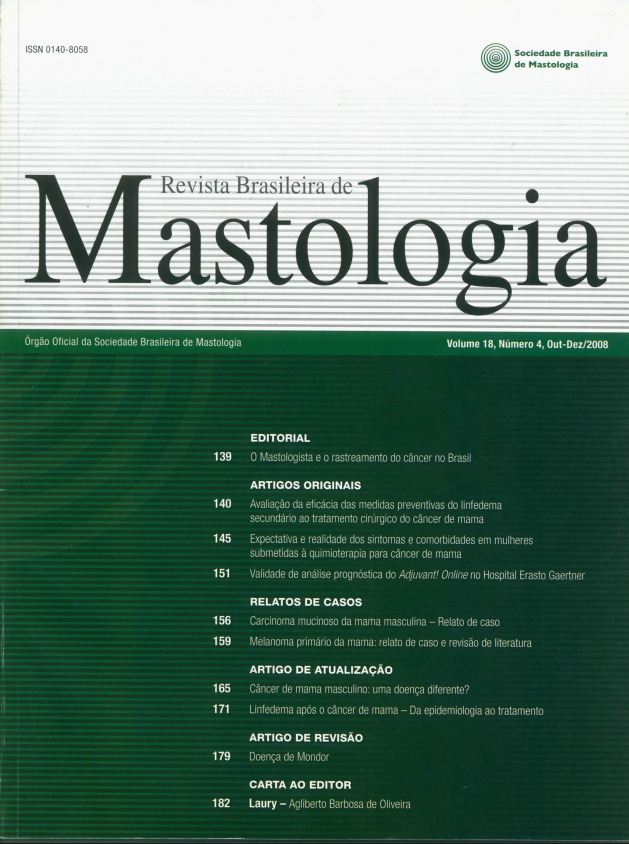
Facts and expectations in women on chemotherapy for breast cancer
Keywords:
Breast cancer, Quality for life, ChemotherapyAbstract
Objective: Thisstudies main goal is to help improve the qualityof life ofpatients who go through chemotherapy
treatment forbreast cancer, evaluating: the prior knowledge of chemotherapyside effectsand aftergoing through
it; the repercussions at the emotional level; all the informations given by the assistant doctor; the influences on
workactivities. Methods: Wesubmitted questionnaires to32 patients whounderwent chemotherapy at the Oncology Departament ofthe Federal University ofRio de Janeiro or in private institution between October 2007
and September 2008. The interview covered thefollowing aspects: psychological wholeness (felings towards
treatment), social (family support and biased conducts), environmental (information available priorto chemо)
and physical (medication used and side effects from drug intake). Results: The middle age was 46,7 years.
Alopecia was the mostknown factor, and the disturbances ofmood appear like apractically unknown one. The
medicationsprescribed in thecontrol of symptoms are efficient in 56,25% (18 patients) of the cases. Thefamiliar
support, the absence of discrimination and the removal ofthe job activities during the treatment are common.The alopecia and nausea were considered itens informed well by the oncologist. And when the chemotherapy
was compared with the prior expectation, the only factor saw itselfseen how worse ofwhat the imagined
went alopecia (14 patients - 50%). Other boarded factors were the same or better than the expected one.
Conclusion: Quality of life tends to be consolidated like an important variable in the clinical practice. It's
development will turn in changes in assistencial practice and in the consolidation of new paradigms of the
process greet disease.
Downloads
References
1. Amichetti M, Caffo O. Pain after quadrantectomy and radiotherapy for early-stage breast cancer: incidence, characteristic and
2.
influence on quality of life. Results from a retrospective study. Oncology. 2003;65(1):23-8.
Bottino RB. Avaliação do perfil das mulheres submetidas à mamografia no Serviço de Radiologia da Santa Casa da Misericórdia do
Rio de Janeiro. Tese de doutorado. Universidade Federal do Rio de
Janeiro; 2005.
3. Bowling A, Brazier J. Quality of life in social science and medicine
introduction. Soc Sci Med. 1995;41:1337-8.
4. Broeckel JA, Jacobsen PB, Balducci L, Horton J, Lyman GH. Quality of life after adjuvant chemotherapy for breast cancer. Breast
Cancer Res Treat. 2000;62(2):141-50.
5. Buzaid AC, Barros AC. Câncer de mama: tratamento multidisciplinar. São Paulo; 2007. р. 36.
6.
7.
8.
9.
Bensi CG, Campos AS, Harada RM, Oliani KR, Ranzatti RP, Samano EST, et al. Aceitação de quimioterapia por brasileiras com
câncer de mama. Rev Assoc Med Bras. 2006;52(1):17-22.
Cohen L, Hack TF, de Moor C, Katz J, Goss PE. The effects of type
of surgery and time on psychological adjustment in women after
breast cancer treatment. Ann Surg Oncol. 2000;7(6):427-34.
Conde DM, Pinto-Neto AM, Cabello C, Santos-Sa D, Costa-Paiva
L, Martinez EZ. Quality of life in Brazilian breast cancer survivors
age 4565 years: associated factors. Breast J. 2005;11(6):425-32.
Conde DM, Pinto-Neto AM, Freitas Jr R, Aldrighi JM. Qualidade
de vida de mulheres com câncer de mama. Rev Bras Ginecol Obstet. 2006;28(3):195-204.
10. Engel J, Kerr J, Schlesinger-Raab A, Sauer H, Holzel D. Quality of
life following breast-conserving therapy or mastectomy: results of
a 5-year prospective study. Breast J. 2004;10(3):223-31.
11. Fleck MP, Leal OF, Louzada S, Xavier M, Cachamovich E, Vieira
G, et al. Desenvolvimento da versão em português do instrumento
de avaliação de qualidade de vida da OMS (WHOQOL-100). Rev
Bras Psiquiatr. 1999;21:21-8.
12. Fleck MPA, Louzada S. Aplicação da versão em português do
instrumento abreviado de avaliação de qualidade de vida "WHOQOL-bref". Rev Saúde Pública. 2002;34(2):9.
13. Godinho ER. Rastreamento do câncer de mama. Aspectos relacionados ao médico. Tese de doutorado. Universidade Federal do Rio
de Janeiro; 2003.
14. Lotti RCB, Barra AA, Dias RC, Makluf ASD. Qualidade de vida
nas mulheres submetidas ao tratamento de câncer de mama. Rev
Bras Cancerologia. 2008;54(4)367-71.
15. Ministério da Saúde. Secretária Nacional de Assistência à Saúde.
Instituto Nacional do Câncer [Inca]. Estimativas de incidência e
mortalidade por câncer no Brasil. Rio de Janeiro; 2007.
16. Rogerson RJ. Environmental and health-related quality of
life: conceptual and methodological similarities. Soc Sci Med.
1995;41:1373-82.
17. Schuttinga JA. Quality of life from a federal regulatory perspective. I:
Dimsdale JE, Baum A, editors. Quality of life in behavioral medicine
research. New Jersey: Lawrece Erlbaum Associates; 1995. p. 31-42.
18. SeidlEMF, Zannon CMLC. Qualidade de vida e saúde: aspectos conceituais e metodológicos. Cad Saúde Pública. 2004:20(2):580-8.
19. Shapiro CL, Recht A. Side effects of adjuvant treatment of breast
cancer. N Engl J Med. 2001;344(26):1997-2008.
20. The Whoqol Group. The World Health Organization quality of
life assesment (WHOQOL): development and general psychometric properties 1998. Soc Sci Med. 1998;46:1569-85.
21. World Health Organization [WHO], International Agency for
Cancer Research [IARC]. Globocan 2000: Cancer incidence,
mortality and prevalence worldwide. Geeve; 2001.
Downloads
Published
How to Cite
Issue
Section
License
Copyright (c) 2026 Sabrina Rossi Perez Chagas, Carlos Ricardo Chagas, Hilton A. Koch

This work is licensed under a Creative Commons Attribution 4.0 International License.