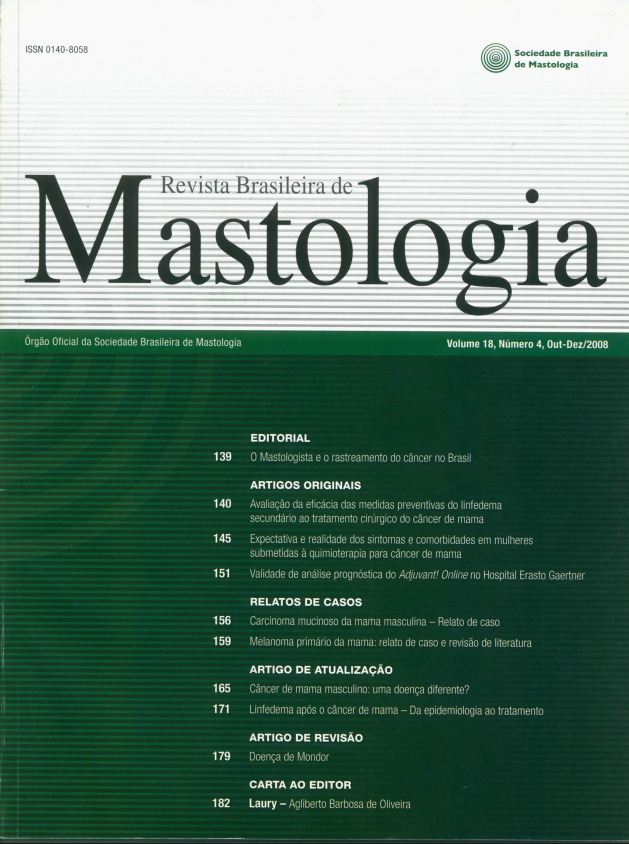
Validity of prognostic analysis of Adjuvant! Online at Erasto Gaertner Hospital
Keywords:
Breast cancer, Adjuvant chemotherapу, Prognosis, Validation, Software, MortalityAbstract
Adjuvant! is a computer of worldwide computer used by oncologists to decide the adjuvant systemic therapy of
Early Breast Cancer, but has only been tested and validated in thepopulation of U.S. and British, never before tested in populations of least developing countries. Methods: Selected 181 patients with breast cancer stage
Iand IItreated over 10-years ago and implemented the programme variables to forecast the overall mortality,
cancer specific mortality, survival free of disease and likelihood ofrecurrence in 10-years. We compared the
average of all patients with the outcome observed. Results: The biggest difference between the predicted and
observed was 6.4% in the calculation ofthe death by cancer, as the overall mortality difference was 4% and
the difference between the interval free of disease was 3.1%. Conclusion: There was no statistically significant difference between the values, demonstrating the program be a good tool in this institution.
Downloads
References
1. ParkA. Breast-cancer basics. Diagnosis and treatment keep changing.
Here's what you need to know now. Time. 2007; 170(16):46-7.
2.
3.
Albain K, Green S, Ravdin P, Cobau C, Levine E, Ingle J, et al.
Overall survival after cyclophosphamide, adriamycin, 5FU and
tamoxifen is superior to tamoxifen alone in postmenopausal, rеceptor (+), node (+) breast cancer: new findings from phase III
Southwest Oncology Group Intergroup trial $8814 (INT-0100)
(abstract). Proc Am Soc Clin Oncol. 2001;20:24a.
Goldhirsch A, Gelber RD, Castiglione M. The magnitude of endocrine effects of adjuvant chemotherapy for premenopausal breast cancer patients. The International Breast Cancer Study Group.
Ann Oncol. 1990;1:183-88.
4. Colleoni M, Gelber S, Goldhirsch A, et al. Tamoxifen after adjuvant chemotherapy for premenopausal women with lymph nodepositive breast cancer: International Breast Cancer Study Group
Trial 13-93. J Clin Oncol. 2006;24:1332-41.
5. Goldhirsch A, Coates AS, Colleoni M, Castiglione-Gertsch M,
Gelber RD. Adjuvant chemoendocrine therapy in postmenopausal breast cancer: cyclophosphamide, methotrexate, and fluorouracil dose and schedule may make a difference. International Breast
Cancer Study Group.J Clin Oncol. 1998;16:1358-62.
6. Berry DA, Cronin KA, Plevritis SK, et al. Effect of screening and
adjuvant therapy on mortality from breast cancer. N Engl J Med. 2005;353:1784-92.
7. Luke C, Gill G, Birrell S, Humeniuk V, Borg M, Karapetis C, et
al. Treatment and survival from breast cancer: the experience of
patients at South Australian teaching hospitals between 1977 and
2003. J Eval Clin Pract. 2006;13(2):212-20.
8. Kenemans P. Quality of life in breast cancer patients. Gynecological Endocrinology: The Official Journal of the International
Society of Gynecological Endocrinology. Gynecol Endocrinol.
2007;23(7):366-7.
9. Habel LA, Shak S, Jacobs MK, et al. A population-based study of
tumor gene expression and risk of breast cancer death among lymph node-negative patients. Breast Cancer Res. 2006;8:R25.
10. Masood S. The knowledge about risk for breast cancer: the patients
right to know. Breast J. 2008;14(3):219-20.
11. Richards MA, O'Reilly SM, Howell A, et al. Adjuvant cyclophosphamide, methotrexate, and fluorouracil in patients with axillary
node-positive breast cancer: an update of the Guy's/Manchester
trial. J Clin Oncol. 1990;8:2032-39.
12. Fisher B, Dignam J, BryantJ, Wolmark N. Five versus more than five
years of tamoxifen for lymph node-negative breast cancer: updated
findings from the National Surgical Adjuvant Breast and Bowel Project B-14 randomized trial. J Natl Cancer Inst. 2001;93:684-90.
13. Paik S, Tang G, Shak S, et al. Gene expression and benefit of chemotherapy in women with node-negative, estrogen receptor-positive breast cancer. J Clin Oncol. 2006;24:3726-34.
14. Ravdin P, Simonoff LA, Davis GJ, et al. Computer program to
assist in making decisions about adjuvant therapy for women with
early breast cancer. J Clin Oncol. 2001;19(4):980-91.
15. Olivotto IA, Bajdik CD, Ravdin PM, et al. Population-based validation of the prognostic model ADJUVANT! for early breast cancer. J Clin Oncol. 2005;23:2716-25.
Downloads
Published
How to Cite
Issue
Section
License
Copyright (c) 2026 Sérgio Bruno Bonatto Hatschbach, Leonardo Dequech Gavarrete, Thatiana Tiemi Ikeda, José Clemente Linhares, João Antônio Guerreiro, Claudiane Ligia Minari

This work is licensed under a Creative Commons Attribution 4.0 International License.