
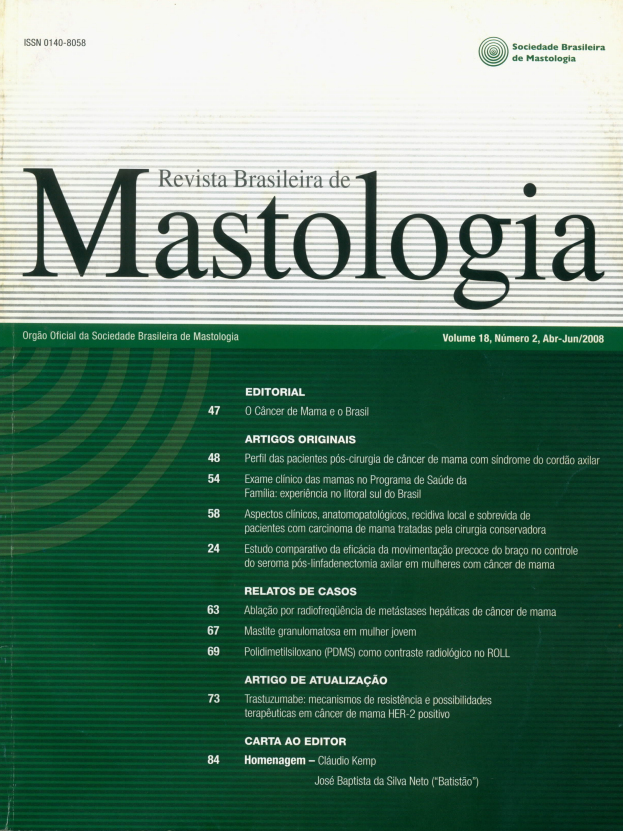
Aspectos clínicos, anatomopatológicos, recidiva local e sobrevida de pacientes com carcinoma de mama tratadas pela cirurgia conservadora
Clinical aspects, histologic findings, local recurrence and survival rates in patients with breast cancer treated with breast conservation surgery
Keywords:
Breast neoplasms, Treatment; Segmental mastectomy, Local neoplasm recurrence, SurvivalAbstract
Purpose: To evaluate the age, the tumor size, the clinical stage, the histologic feature, survival and local
recurrence rates of the patients treated with breast conservation therapy in early breast cancer at Federal
University of Sao Paulo (Unifesp). Methods: A retrospective study ofthe patient's medical records was
conducted. The patients selected for the study were those who had undergone breast conservation therapy
for early stage breast cancer, such as quadrantectomy with axillary dissection and radiotherapy, between
1990 and 2002 at Mastology Discipline of Gynecology Department of Unifesp. The age, tumor size, clinical stage, histologic type, survival and local recurrence rates were assessed and compared with datafrom
the current literature. Results: The patients aged 23 to 88 years (median = 53.7).The tumor size was 0.5
to 4.0 cm (median 1.9 cm); 60.1 percent of women were in stage I, 34.4% in stage IIA, 4.9% in IIB and
0.6% in III. Concerning histologic feature, 83.1% were invasive ductal carcinoma and 7.1% lobular
carcinoma. The survival rate of 97.3 % and local recurrence rate of 3.9 in a 44.5 months offollow-up.
Conclusions: The breast conservation therapy has become the method of choicefor the treatment of early
stage breast carcinoma and our results were comparable with the literature.
Downloads
References
1. Benda RK, Mendenhall NP, Lind DS, Cendan JC, Shea BF, Richardson LC, et al. Breast conserving therapy (BCT) for early stage breast cancer. J Surg Oncol. 2004;85:14-27.
2. Veronesi U, Saccozzi R, Del Vecchio M, Banfi A, Clemente C, De
Lena M, et al. Comparing radical mastectomy with quadrantecсtomy, axillary dissection, and radiotherapy in patients with small
cancers of the breast. N Engl J Med. 1981;305:6-11.
3. Salvadori B, Veronesi U. Conservative methods for breast cancer of
small size: the experience of the National Cancer Institute, Milan
(1973-1998). Breast. 1999;8:311-4.
4. Fisher B, Anderson S, Redmond CK, Wolmark N, Wickerham
DL, Cronin WM. Reanalysis and results after 12 years of follow
up in a randomized clinical trial comparing total mastectomy with
lumpectomy with or without irradiation in the treatment of breast
cancer. N Engl J Med. 1995;333:1456-61.
5.
6.
Jacobson JA, Danforth DN, Cowan KH, d'Angelo T, Steinberg
SM, Pierce L, et al. Ten year results of a comparison of conservation with mastectomy in the treatment of stage I and II breast
cancer. N Engl J Med. 1995;332:907-11
Van Dongen JA, Bartelink H, Fentiman IS, Lerut T, Mignolet
F, Olthuis G, et al. Factors influencing local relapse and survival
and results of salvage treatment after breast conserving therapy in
operable breast cancer: EORTC trial 10801, breast conservation
compared with mastectomy in TNM Stage I and II breast cancer.
Eur J Cancer. 1992;28A:801-5.
7. Arriagada R, Le MG, Rochard F, Contesso G. Conservative treatment versus mastectomy in early breast cancer: patterns of failure
with 15 years of follow up data. Institute Gustave Roussy Breast
Cancer Group. J Clin Oncol. 1996;14:1558-64.
8. Morrow M, Strom EA, Basset LW, Dershaw DD, Fowble B. Giuliano A, et al. Standard for breast conservation therapy in the
management of invasive breast carcinoma. CA Cancer J Clin.
2002:52:277-300.
9. Kalbfleisch JD, Prentice RL. The statistical analysis of failure time
data. New York: Wiley Series in Probability and Satistics; 1980.
10. Agresti A. An introduction to categorical data analysis. New York:
John Wiley and Sons; 1996.
11. Veronesi U, Cascinelli N, Mariani L, Greco M, Saccozzi R, Luini
12.
A, et al. Twenty-year follow up of a randomized study comparing
breast conserving surgery with radical mastectomy for early breast
cancer. N Engl J Med. 2002;347:1227-32.
Fisher B, Anderson S, Bryant J, Margolese RG, Deutsch M, Fisher
ER, et al. Twenty year follow up of a randomized trial compаring total mastectomy, lumpectomy, and lumpectomy plus irradiation for the treatment of invasive breast cancer. N Engl J Med.
2002:347:1233-41.
13. Veronesi U, Del Vecchio M, Manzari A, Andreola S, Greco M,
Luini A, et al. Local recurrences and distant metastases after conservative breast cancer treatments: partly independent events. J
Natl Cancer Inst. 1995;87:19-27.
14. Veronesi U, Salvadori B, Luini A, Greco M, Saccozzi R, del Vecchio M, et al. Breast conservation is a safe method in patients with
small cancer of the breast. Long term results of three randomized
trials on 1,973 patients. Eur J Cancer. 1995;31A:1574-9.
15. Poggi MM, Danforth DN, Sciuto LC, Smith SL, Steinberg SM,
Liewehr DJ, et al. Eighteen-year results in the treatment of early
breast carcinoma with mastectomy versus breast conservation therapy: The National Cancer Institute Randomized Trial. Cancer.
2003;98:697-702.
Downloads
Published
How to Cite
Issue
Section
License
Copyright (c) 2026 Amanda Neves Machado, Gil Facina, Luiz Henrique Gebrim

This work is licensed under a Creative Commons Attribution 4.0 International License.