
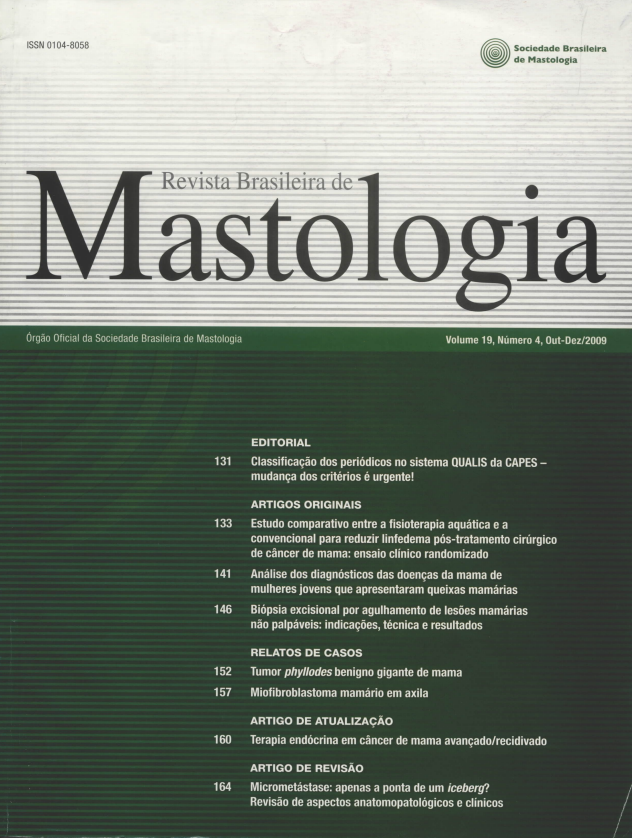
Comparative study between the aquatic physiotherapy and the conventional for lymphedema reduction after surgical treatment for breast cancer: randomized clinical trial
Keywords:
Physical therapy, Breast neoplasms, LymphedemaAbstract
Objective: Thepresent study has for objective to compare two methods ofphysiotherapeutic treatments for
lymphedema after surgical treatment for breast cancer. Methods: A randomized clinical trial was used.
Had been part ofthe research 58 women, submitted to the surgical treatment for the breast cancer, who
had developed lymphedema ofsuperior member, being the patients divided in two groups of 29 patients
each, and this way, one was treated with the aquatic physiotherapy and the other with the conventional physiotherapy, the lymphedema was measured through the perimeter of superior member. Results: The
groups demonstrated perimetrical variable homogeneity. The group submitted to the aquatic physiotherapy demonstrated a significant reduction of lymphedema in all the seven evaluated points, before and after the treatment, while the group submitted to the conventional physiotherapy, presented reduction in
only three of thepoints (p < 0.05). Discussion: The hydrostatic pressure, exerted equally on the body, and directly proportional to the depth, acts in favor of the lymphatic draining, being able to reduce the lym- phedema. Conclusion: The aquatic physiotherapy can be considered an efficient method for treatment
of lymphedema aftersurgical treatmentfor breast cancer, considering the homogenical reduction result of
the superior member perometer.
Downloads
References
1. Instituto Nacional de Câncer. Estimativa 2008: incidência
de câncer no Brasil. Disponível em: <http://www.inca.gov.br/
estimativa/2008/index.asp?link=tabelaestados.asp&UF=BR>.
Acesso em 08/09/2008.
2. Ravdin PM, Cronin KA, Howlader N, Berg CD, Chlebowski RT,
Feuer EJ, et al. The decrease in breast-cancer incidence in 2003 in
the United States. N Engl J Med. 2007;356(16):1670-4.
3. Bergmann A, Mattos IE, Koifman RJ. Diagnóstico do linfedema:
análise dos métodos empregados na avaliação do membro superior
após linfadenectomia axilar para tratamento do câncer de mama.
Revista Brasileira de Cancerologia. 2004;50:311-20.
4. Szuba A, Achalu R, Rockson SG. Decongestive lymphatic therapy
for patients with breast carcinoma-associated lymphedema. Cancer. 2002;95:2260-7.
5. Andrade MFC. Linfedema. In: Pitta GBB, Castro AA, Burihan
E, (eds.). Angiologia e cirurgia vascular: guia ilustrado. Maceió:
UNCISAL/ECMAL/LAVA, 2008. Disponível em: http://www.lava.
med.br/livro/pdf/mauro_linfedema.PDF. Acesso em 08/09/2008.
6.
7.
Karad BD, Yurdalan SU, Saydam S, Arican Z. The comparison of
two different physiotherapy methods in treatment of lymphedema after breast surgery. Breast Cancer Research and Treatment.
2005;93:49-54.
Skinner AT, Thonson AM, eds. Duffield: exercícios na água. São
Paulo: Manole; 1985.
8. Bates A, Hanson N. Exercícios aquáticos terapêuticos. São Paulo:
Manole, 1998.
9. Moher D, Schulz KF, Altman DG. The consort statement: revised
recommendations for improving the quality of reports of parallelgroup randomised trials. Lancet. 2001;357:1191-4.
10. Panobianco MS, Mamede MV. Complicações e intercorrências
associadas ao edema de braço nos três primeiros meses pós-mastectomia. Rev Lat Am Enfermagem. 2002;10:544-51.
11. Pocock SJ. Clinical trials: a practical approach. Chichester: Wiley; 1996.
12. Megens AM, Harris SR, Kim-Sing C, McKenzie DC. Measurement of upper extremity volume in women after axillary dissection
for breast cancer. Arch Phys Med Rehabil. 2001;82:1639-44.
13. Petrek JA, Heelan MC. Incidence of breast carcinoma: related
lymphedema. Cancer. 1998:83:2776-81.
14.
15.
Camargo MC, Marx AG. Reabilitação física no câncer de mama.
São Paulo: Roca; 2000.
Bergmann A. Prevalência de linfedema subsequente a tratamento
cirúrgico para câncer de mama no Rio de Janeiro (tese de mestrado). XIV. Rio de Janeiro: Fundação Oswaldo Cruz/Escola Nacional de Saúde Pública; 2000, 142p.
16. Freitas Junior R, Ribeiro LFJ, Taia L, et al. Lymphedema in breast cancer patients submitted to modified radical mastectomy. Rev
Bras Ginecol Obstet. 2001;23:205-8.
17. Harris SR, Hugi MR, Olivotto IA, Levine M. Clinical practice
guidelines for the care and treatment of breast cancer: lymphedema. CMAJ. 2001;164:191-8.
18. American Cancer Society Lymphedema Work Group. Diagnosis and management of lymphedema. Cancer. 1998;(suppl. 83):
2882-5.
19. Moretti B, Lanzisera R, Moretti L, Kajita D, Fernandes MV,
Queiroz GS. Linfodrenaggio manuale nel "braccio grosso" postmastectomia. G Ital Med Lav Ergon. 2005;27(2):160-4.20. Taylor R, Jayasinghe UW, Koelmeyer L, Ung O, Boyages J. Reliability and validity of arm volume measurements for ass assessment of
lynphedema. Phys Ther. 2006;86(2):205-14.
21. Pezner RD, Patterson MP, Hill LR, Lipsett JA, Desai KR, Vora N,
et al. Arm lymphedema in patients treated conservatively for breast
cancer: relationship to patients' age and axillary node dissection
technique. Int J Radiat Oncol Biol Phys. 1986;12(12):2079-83.
22. Wilburn O, Wilburn P, Rockson SG. A pilot, prospective evaluation of a novel alternative for maintenance therapy of breast
cancer-associated lymphedema. BMC Cancer. 2006;6:176-80.
23. Prado MAS, Mamede MV, Almeida AM, Clapis MJ. A prática da
atividade física em mulheres submetidas à cirurgia por câncer de
mama: percepção de barreiras e benefícios. Rev Lat Am Enfermagem. 2004;12:494-502.
Downloads
Published
How to Cite
Issue
Section
License
Copyright (c) 2026 Adriana Paula Fontana Carvalho, Elbens Marcos Minoreli de Azevedo

This work is licensed under a Creative Commons Attribution 4.0 International License.