
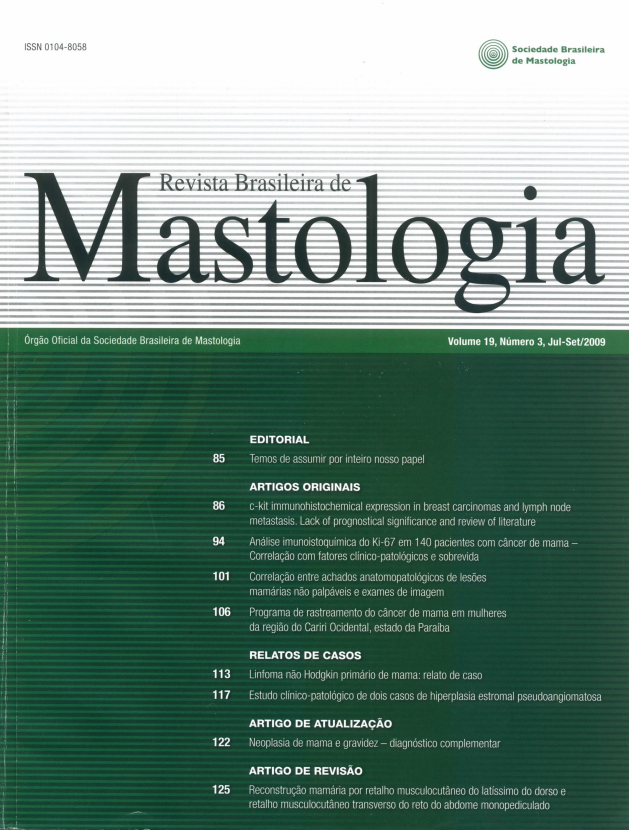
Immunohistochemical analysis of Ki-67 in 140 patients with breast cancer - Correlation with clinicopathological factors and survival
Keywords:
Breast cancer, Ki-67, Immunodetection, Prognostic factor, SurvivalAbstract
The Ki-67 antigen is used to evaluate proliferative activity in several tumors. However the role of the
Ki-67 as a prognostic factor in breast cancer is still undefined. The aim of present study was to analyze
the expression of Ki-67 antigen correlating with clinicopathological factors and survival in patients with
breast cancer. We carried out an immunohistochemical analysis using MIB-1 monoclonal antibody in
140 specimen of breast cancer ofwomen with age between 27 and 90 years. The cut-off point was 25%.The five year overall survival was 77.1%. There was a significant worse survival of patients with node
positive (p < 0.0001), larger tumors (p < 0.0001), more advanced stages (p < 0.0001) and with negative
hormonal receptors (p = 0.019). Patients with Ki-67 immunodetection in more than 25% ofthe tumors
cells showed a poorer outcome when compared with those that express Ki-67 in less than 25% of the
cells examined (70.8% x 82.7%), however this difference was not statistically significative (p = 0,094).
The overexpression of Ki-67 did not correlate with a worse survival in the group ofpatients analyzed.
Downloads
References
1. Laguens G, Coronato S, Girolamo W. Biomarkers in breast cancer.
Cent Eur J Med. 2006;1(4):330-47.
2. Colozza M, Azambuja E, Cardoso F, Sotiriou C, Larsimont D,
Piccart MJ. Proliferative markers as prognostic and predictive
tools in early breast cancer: where are we now? Ann Oncol. 2005;
16:1723-39.
3.
4.
Schindlbeck C, Kampik T, Janni W, Rack B, Jeschke U, Krajewski
S, et al. Prognostic relevance of disseminated tumor cells in the
bone marrow and biological factors of 265 primary breast carcinomas. Breast Cancer Res. 2005;7:1174-85.
Gerdes J, Li L, Schlueter C, Duchrow M, Wohlenberg C, Gerlach
C, et al. Immunobiochemical and molecular biologic characterization of the cell proliferation associated nuclear antigen that is defined by monoclonal antibody Ki-67. Am J Pathol. 1991;138:867-73.
5. Gerdes J, Schwab U, Lemke H, Stein H. Production of a mouse
monoclonal antibody reactive with a human nuclear antigen associated with cell proliferation. Int J Cancer. 1983;31:13-20.
6.
7.
8.
9.
Gerdes J, Lemke H, Baisch H, Wacker H-H, Schwab U, Stein Н.
Cell cycle analysis of a cell proliferation-associated human nuclear
antigen defined by the monoclonal antibody Ki-67. J Immunol.
1984;133:1710-5.
Trihia H, Murray S, Price K, Gelber RD, Golouh R, Goldhirsch
A, et al. Ki-67 expression in breast carcinoma: its association with
grading systems, clinical parameters, and other prognostic factors
- a surrogate marker? Cancer. 2003;97:1321-31.
Spyratos F, Ferrero-Poüs M, Trassard M, Hacène K, Phillips E,
Tubiana-Hulin M, et al. Correlation between MIB-1 and other
proliferation markers: clinical implications of the MIB-1 cutoff value. Cancer. 2002;94(8):2151-9.
Fonatsch C, Duchrow M, Rieder H, Schlüter C, Gerdes J. Assignment of the human Ki-67 gene (MK167) to 10q25-qter. Genomics. 1991;11:476-7.
10. Schlüter C, Duchrow M, Wohlenberg C, Becker MHG, Key G,
Flad H-D, et al. The cell proliferation-associated antigen of antibody Ki-67: a very large, ubiquitous nuclear protein with numerous repeated elements, representing a new kind of cell cycle-maintaining proteins. J Cell Biol. 1993;123:513-22.
11. Kill IR. Localisation of the Ki-67 antigen within the nucleolus:
evidence for a fibrillarin-deficient region of the dense fibrillar component. J Cell Sci. 1996;109:1253-63.
12. Urruticoechea A, Smith IE, Dowsett M. Proliferation marker Ki67 in early breast cancer. J Clin Oncol. 2005;23:7212-20.13.
14.
15.
Shaaban AM, Sloane JP, West CR, Foster CS. Breast cancer risk
in usual ductal hyperplasia is defined by estrogen receptor-α and
Ki-67 expression. Am J Pathol. 2002;160:597-604.
Mirza AN, Mirza NQ, Vlastos G, Singletary SE. Prognostic factors in node-negative breast cancer: a review of studies with sample
size more than 200 and follow-up more than 5 years. Ann Surg.
2002;235:10-26.
Azambuja E, Cardoso F, De Castro Jr G, Colozza M, Mano MS,
Durbecq V, et al. Ki-67 as a prognostic marker in early breast cancer: a meta-analysis of published studies involving 12 155 patients.
Br J Cancer. 2007;96:1504-13.
16. Stuart-Harris R, Caldas C, Pinder SE, Pharoah P. Proliferation
markers and survival in early breast cancer: A systematic review
and meta-analysis of 85 studies in 32,825 patients. Breast. 2008;
17(4):323-34.
17. Mendonça GAS, Silva AM, Caula WM. Características tumorais e
sobrevida de cinco anos em pacientes com câncer de mama admitidas no Instituto Nacional de Câncer, Rio de Janeiro, Brasil. Cad
Saúde Pública. 2004;20(5):1232-9.
18. Park D, Kåresen R, Noren T, Sauer T. Ki-67 expression in primary
breast carcinomas and their axillary lymph node metastases: clinical implications. Virchows Arch. 2007;451:11-8.
Downloads
Published
How to Cite
Issue
Section
License
Copyright (c) 2026 Wilmar José Manoel, Diego Franciel Marques Mühlbeier, Leonardo Barcelos de Paula, Willana Caparelli Cimino de Araújo, Fábio Marques de Almeida, Gustavo Nogueira Caixeta, Élbio Cândido de Paula, Deidimar Cássia Batista Abreu, Lorena Gonçalves Leal, Vera Aparecida Saddi

This work is licensed under a Creative Commons Attribution 4.0 International License.