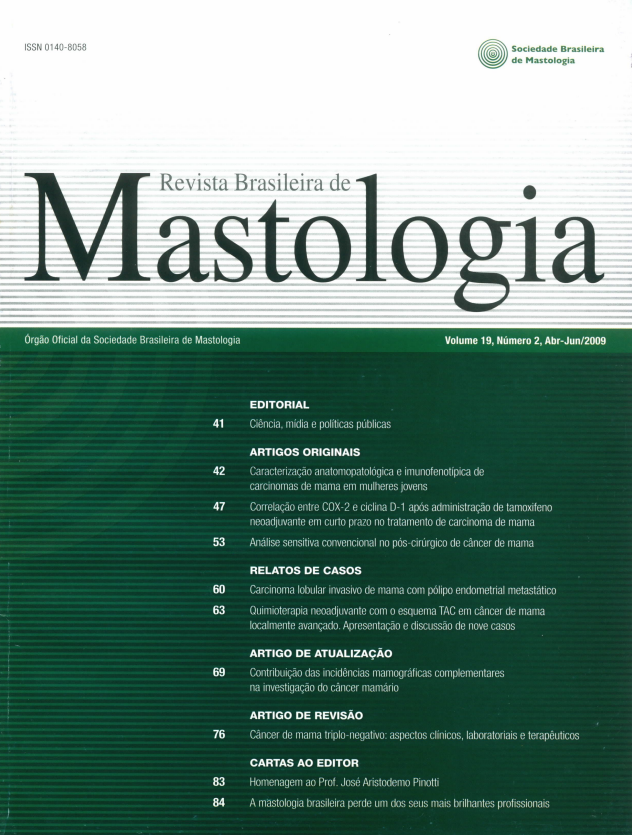
Correlation of COX-2 and ciclyn D-1 after short-time neoadjuvant tamoxifen on breast cancer
Keywords:
COX-2, Ciclyn D-1, Tamoxifen, Breast cancerAbstract
Introduction: Tamoxifen is the most used drug in the hormonal therapy of the breast cancer. Ciclyn D-1,
one CCNDI gene product's (PRADI), is essential for the normal lobule-alveolar mammary development
and acts in the cellular cycle control. Ciclyn D-1 superexpression act negatively in tamoxifen treatment,and may contribute to predict the failure observed in some patients. COX-2 activity induces oestrogen oxidation to dietilstilbestrol and promotes genotoxics effects on the breast. Ciclyn D-1 and COX-2 association
had not been described yet to short time tamoxifen treatment. Objective: Evaluate short time (14 days)
neaodjuvant tamoxifen effects on COX-2 and ciclyn D-1 expression in breast cancer patients. Methods:
Randomized prospective study in the Federal University of Sao Paulo. Twenty five patients with stage II
and III breast cancer were included. The groups were control (n = 13) and treatment (n = 12). Ciclyn
D-1 and COX-2 samples were evaluated before and after treatment. Imunohistochemistry was performed
on the tissue sections using a polyclonal antibody to COX-2 (Novocastra - Clone 4H12) and cyclin D-1
(Novocastra – Clone DCS-6). The results were classified according Already score, based on the intensity
and fraction marked cells. Results: COX-2 was positive in 56% of tumors. No significant difference was
observed between the two groups (p = 0.39 Mann Whitney test). The Difference of cyclin D-1 medium
(post - pre) in the control group was 5, while in the tamoxifen group was 0.5. (p = 0.08, Mann Whitney
test). Correlation between COX-2 and ciclyn D-1 was expressed by Pearson index (r). In treatment group
moderate linear and positive correlation was observed (r = 0.51 – Pearson's index) (p = 0.08). It wasn't
observed in control group (r = 0.42) (p = 0.12). Conclusion: Tamoxifen treatment in short time period
(14 days) wasn't modified significantly COX-2 and ciclyn D-1 expression.
Downloads
References
1. Pritchard KI. The best use of endocrine treatments. The Breast.
2003:12:497-508.
2. Early Breast Cancer Trialist Collaborative Group. Effects of chemotherapy and hormonal therapy for early breast cancer on recurrence and 15 year survival: an overview of the randomized trials.
Lancet. 2005;365:1687-717.
3. Cuzick J, Powles T, Veronesi U, Forbes J, Edwards R, Ashley S, et al.
Overview of the main outcomes in breast cancer prevention. Lancet.
2003;361:296-300.4.
Millen EC et al.
Ring A, Dowsett M. Mechanisms of tamoxifen resistance. Endocr
Relat Cancer. 2004;11:643-58.
5. Milano A, Dal Lago L, Sotiriou C, Piccart M, Cardoso F. What
clinicians need to know about antiestrogen resistance in breast
cancer therapy. Eur J Cancer. 2006;42:2692-705.
6. Ormandy CJ, Musgrove EA, Hui R, Daly RJ, Sutherland RL.
Cyclin D1, EMS1 and 11q13 amplification in breast cancer. Breast
Cancer Res Treat. 2003;78:323-35.
7.
8.
9.
Hui R, Finney GL, Carrol JS, Lee CSL, Musgrove EA, Sutherland
RL. Constitutive overexpression of cyclin D-1 but not cyclin E
confers acute resistance to antiestrogens in T-47D breast cancer
cells. Cancer Res. 2002:62:6916-23.
Musgrove EA, Hamilton JA, Lee CS, Sweeney KJ, Watts CK, Sutherland RL. Growth factor, steroid, and steroid antagonist regulation
of cycline gene expression associated with changes in T-47D human
breast cancer cell Cycle progression. Mol Cell Biol. 1993;13:3577-87.
Musgrove EA, Lee CS, Buckley ML, Sutherland RL. Cyclin D1
induction in breast cancer cells shortens G1 and is sufficient for
cells arrested in G1 to complete the cell Cycle. Proc Natl Acad Sci
USA. 1994:91:8022-6.
10. Gillet C, Fantl V, Fisher C, Bartek J, Dickson C, Barnes D, et al. Amplification and overexpression of cyclin D1 in breast cancer detected
by immunohistochemical staining. Cancer Res. 1994;54:1812-7.
11. Bartkova J, Lukas J, Muller H, Lützhoft D, Strauss M, Bartek J.
Cyclin D1 protein expression and function in human breast cancer. Int J Cancer. 1994;57:353-61.
12. Alle K, Henshall S, Field A, Sutheland RL. Cyclin D1 protein
is overexpressed in hyperplasia and intraductal carcinoma of the
breast. Clin Cancer Res. 1998;54:1812-7.
13. Zwijsen RML, Wientjens E, Klompmaker R. CDK independent
activation of estrogen receptor by cyclin D1. Cell. 1997;88:405-15.
14. Roy PG, Thompson Am. Cyclin D1 and breast cancer. The Breast.
2006;15:718-27.
15. Wang TC, Cardiff RD, Zukerberg L, Lees E, Arnold A, Schmidt
EV. Mammary hyperplasia and carcinoma in MMTV - cyclin D1
transgenic mice. Nature. 1994;69:669-71.
16. Barnes DM, Gillet C. Cyclin D-1 and breast cancer. Breast Cancer
Res Treat. 1998;52:1-15.
17. Méric JB, Rottey S, Olaussen K, Soria JC, Khayat D, Rixe O, et al.
Cyclooxygenase as a target for anticancer drug development. Crit
Rev Oncol Hematol. 2006;59:51-64.
18. Denkert C, Winzer KJ, Muller BM, Weichert W, Pest S, Kobel M,
et al. Elevated Expression of Cyclooxigenase-2 is Negative prognostic factor for disease free survival and overall survival in patients with breast carcinoma. Cancer. 2003;97:2978-87.
19. Tsutsui T, Tamara Y, Yagi E, et al. Involvement of genotoxic effects
in the initiation of estrogen-induced cellular transformation studies using Syrian hamster embryo cells treated with 17 beta-estradiol and eight of its metabolites. Int J Cancer. 2000;86:8-14.
20. Chow LWC, Wong JL, Toi M. Celecoxib anti-aromatase neoadjuvant (CAAN) trial for locally advanced breast cancer: preliminary
report. J Steroid Biochem Mol Biol. 2003;86:443-7.
21. Allred DC, Harvey JM, Berardo MD. Prognostic and predictive
factors in breast cancer by immunohistochemical analysis. Mod
Pathol. 1998;11:155-68.
22. Harvey J, Clark GM, Osborne KC, Allred CD. Estrogen receptor
status by immunohistochemistry is superior to the ligand-binding
assay for predicting response to adjuvant endocrine therapy in
breast cancer. J Clin Oncol. 1999;17:1474-81.23. Stendahl M. Cyclin D1 overexpression is a negative predictive factor for tamoxifen response in postmenopausal breast cancer. Br J
Cancer. 2004;90:1942-8.
24. Jirsröm K, Stendhal M, Ryden L, Kronblad A, Bendahl PO, Stal
O, et al. Adverse effect of adjuvant tamoxifen in premenopausal breast cancer with cyclin D1 gene amplification. Cancer Res.
2005:65:8009-16.
25. Half E, Tang XM, Gwyn K, Sahin A, Wathen K, Sinicrope FA.
Cyclooxygenase-2 expression in human breast cancers and adjacent ductal carcinoma in situ. Cancer Res. 2002;62:1676-81.
26. McCarthy K, Bustin SA, Ogunkolade B, Khalaf S, Laban CA, McVittie CJ, et al. Cyclo-oxigenase-2 (COX-2) mRNQ expression and
hormone receptor status in breast cancer. EJSO. 2006;32:707-9.
27. Chow LWC, Loo WTY, Toi M. Current directions for COX-2 inhibition in breast cancer. Biomed Pharmacot. 2005;59:S281-4.
28. Gierach GL, Lacey JV, Schatzkin A, Leitzmann MF, Richesson
D, Hollenbeck AR, et al. Nonsteroidal anti-inflammatory drugs
and breast cancer risk in the national institute of health. AARP
Diet and Health Study. Breast Cancer Res Treat. 2008;10:R38.
(doi.10.1186/bcr2089)
29. Sorlie T, Perou C, Tibshirani R, Aas T, Gesler S, Johnsen H, et al.
Gene expression patterns of breast carcinoma distinguish tumor
subclasses with clinical implications. PNAS. 2001;98: 10869-74.
30. Paik S, Shak S, Tang G, Kim C, Baker J, Cronin M, et al. Multigene assay to predict recurrence of tamoxifen-treated, node-negative breast cancer. N Engl J Med. 2004;351:2817-26.
Downloads
Published
How to Cite
Issue
Section
License
Copyright (c) 2026 Eduardo C. Millen, Marcelo Madeira, Angela F. Logullo Waitzberg, Fernando A. Soares, Cyntia Osório, Suely Nonogaki, Luiz H. Gebrim

This work is licensed under a Creative Commons Attribution 4.0 International License.