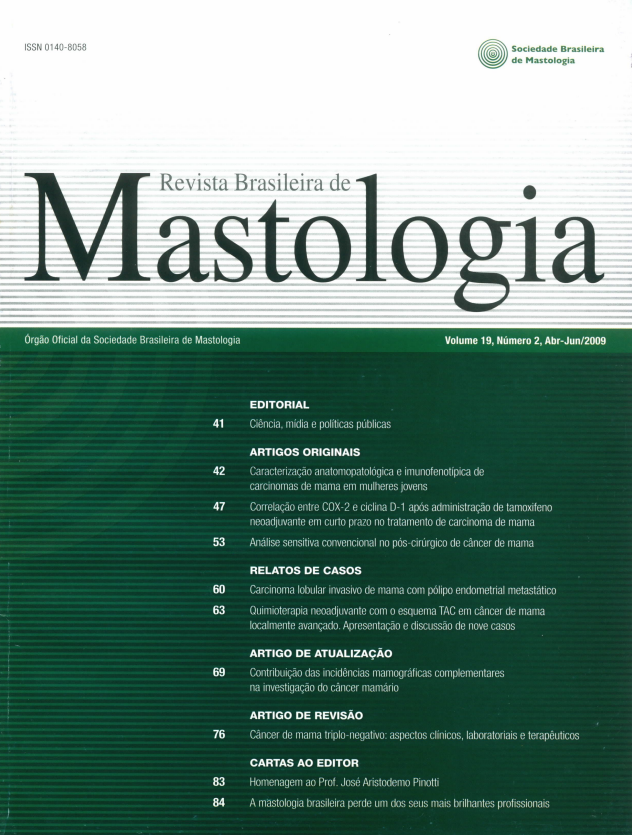
Pathological and molecular characterization of breast carcinomas of young women
Keywords:
Young woman, Mammary carcinoma, Genetic profile, Molecular profile, ImmunohistochemistryAbstract
Aims: To analyse pathologicalfeatures and immunohistochemical profile of breast carcinomas in women
35 years or less. Methods: Retrospective study with analysis of the cases received from 1997 to 2007.
We identified 909 (6.6%) cases of breast cancer in young women, 314 of them with available paraffin
blocks. A control group of 81 patients above age of 60 was selected. All the cases were revised regarding
histological features. The immunohistochemical detection ofER, PR and HER2 was carried on 291 cases
of young women and 74 in olders. The tumors were categorized as luminal (positive ER andlor PR),
HER2 (negative ER and RP, and positive HER2 ), and triple-negative (negative ER, PR and HER2).
Results: The ductal histological type was the most frequent one in the two groups (95.2% in young and
83.9% above 60 years). Infiltrative lobular carcinoma was less frequent in the young group (2.5% х12.3%), although the pleomorphic subtype was more frequent. Young women more oftenpresented with
high grade tumors (41.7% x 28.4%) and showed a trend to more circumscribed tumors (8.2% x 7.4%)
and necrosis (23.2% x 16.0%). The luminal profile was morefrequent in the two groups, although with
lower frequency among younger (64.9% x 81.1%). These presented more triple-negative profile (27.1%
x 17.6%), more overexpression of HER2 (16.5% x 5.4%), as well as the molecular profile HER2 (7.9%
x 1.3%). Conclusions: The results point to intrinsic differences in the tumors arising in young women
characterized by more aggressive morphological and immunohistochemical profiles.
Downloads
References
1. Greene FL, Page DL, Fleming ID, Fritz A, Balch CM, Haller DG,
et al. AJCC Cancer Staging Manual. 6th ed. New York, NY: Springer-Verlag; 2002.
2. Goldrirsch A, Wood, WC, Gelber RD, Coates AS, Thürlimann B,
Senn HJ; 10th St. Gallen conference et al. Progress and promise:
highlights of the international expert consensus on the primary therapy of early breast cancer 2007. Ann Oncol. 2007;18:1133-44.
3. Adjuvant! Online - Decision making tools for health care professionals [Online]. 2008. Disponível em: http://www.adjuvantonline.com
4. Fitzgibbons PL, Page DL, Weaver D, Thor AD, Allred DC, Clark
GM, et al. Prognostic factors in breast cancer. College of American
Pathologists Consensus Statement 1999. Arch Pathol Lab Med.
2000;124:966-78.
5. Perou CM, Sorlie T, Eisen MB, Van de Rijn M, Jeffrey SS, Rees
CA, et al. Molecular portraits of human breast tumours. Nature.
2000;406(6797):747-52.
6. Sorlie T, Perou CM, Tibshirani R, Aas T, Geisler S, Johnsen H,
et al. Gene expression patterns of breast carcinomas distinguish
tumor subclasses with clinical implications. Proc Natl Acad Sci U
S A. 2001;98:10869-74.
7. Sorlie T, Wang Y, Xiao C, Johnsen H, Naume B, Samaha RR,
Børresen-Dale AL. Distinct molecular mechanisms underlying clinically relevant subtypes of breast cancer: gene expression analyses
across three different platforms. BMC Genomics. ics. 2006;26(7):127.
8. Nielsen TO, Hsu FD, Jensen K, Cheang M, Karaca G, Hu Z,
et al. Immunohistochemical and clinical characterization of the
basal-like subtype of invasive breast carcinoma. Clin Cancer Res.
2004;10:5367-74.
9. Carey LA, Perou CM, Livasy CA, Dressler LG, Cowan D, Conway
K, et al. Race, breast cancer subtypes, and survival in the Carolina
Breast Cancer Study. JAMA. 2006;295:2492-502.
10. Cheang MC, Voduc D, Bajdik C, Leung S, McKinney S, Chia SK,
et al. Basal-like breast cancer defined by five biomarkers has superior prognostic value than triple-negative phenotype. Clin Cancer
Res. 2008;14:1368-76.
11. Ross JS, Hatzis C, Symmans WF, Pusztai L, Hortobágyi GN..
Commercialized multigene predictors of clinical outcome for breast cancer. The Oncologist. 2008;13:477-93.
12. Livasy CA, Karaca G, Nanda R, Tretiakova MS, Olopade OI, Moore DT, Perou CM. Phenotypic evaluation of the basal-like subtype of invasive breast carcinoma. Mod Pathol. 2006;19:264-71.
13. Korsching E, Jeffrey SS, Meinerz W, Decker T, Boecker W, Buerger H. Basal carcinoma of the breast revisited: an old entity with
new interpretations. J Clin Pathol. 2008;61;553-60.
14. Rakha EA, Putti TC, Abd El-Rehim DM, Paish C, Green AR,
Powe DG, et al. Morphological and immunophenotypic analysis
of breast carcinomas with basal and myoepithelial differentiation.
J Pathol. 2006;208:495-506.
15. Leibl S, Gogg-Kammerer M, Sommersacher A, Denk H, Moinfar F. Metaplastic breast carcinomas: are they of myoepithelial
differentiation? Immunohistochemical profile of the sarcomatoid
subtype using novel myoepithelial markers. Am J Surg Pathol.
2005;29:347-53.
16. Weigelt B, Horlings HM, Kreike B, Hayes MM, Hauptmann M,
Wessels LF, et al. Refinement of breast cancer classification by
molecular characterization of histological special types. J Pathol.
2008;216:141-50.
17. El Saghir NS, Seoud M, Khalil MK, Charafeddine M, Salem ZK,
Geara FB, et al. Effects of young age at presentation on survival in
breast cancer. BMC Cancer. 2006;6:194.
18. Anders CK, Hsu DS, Broadwater G, Acharya CR, Foekens JA,
Zhang Y, et al. Young age at diagnosis correlates with worse prognosis and defines a subset of breast cancers with shared patterns of
gene expression. J Clin Oncol. 2008;26:3324-30.
Downloads
Published
How to Cite
Issue
Section
License
Copyright (c) 2026 Lívia Moscardi Bacchi, Marcus Corpa, Carlos E. Bacchi, Filomena M. Carvalho

This work is licensed under a Creative Commons Attribution 4.0 International License.