
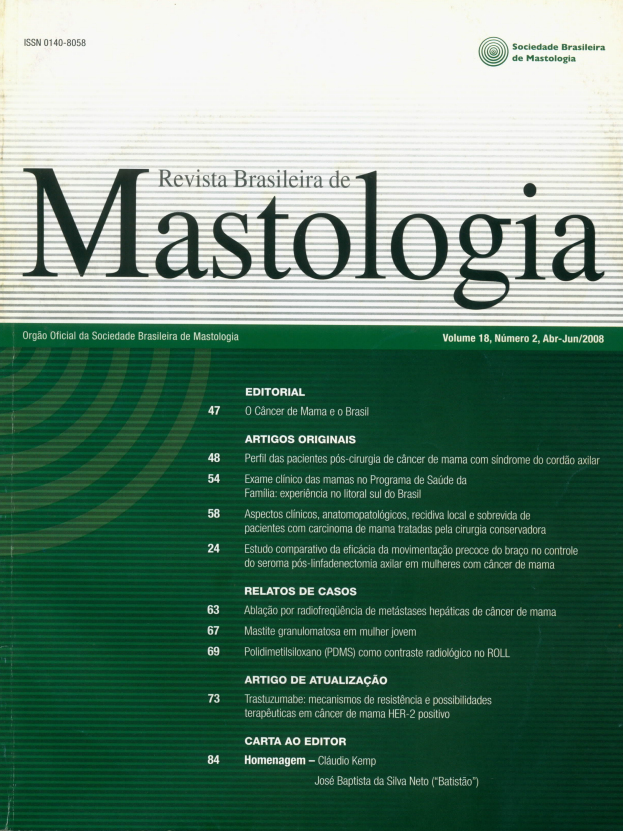
Profile of the patients after breast cancer surgery with axillary web syndrome
Keywords:
Axillary web syndrome, Breast cancer, Axillary dissectionAbstract
Breast cancer represents the second mostfrequent type of cancer in the world and the one that most causes
death among women. This study aimed at analyzing the profile of patients from the Cancer Hospital of
Pernambuco and from FIR, after a breast cancer surgery with Axillary Web Syndrome (AWS), by means
of medical and physical therapeutic records. Within the 112 evaluated patients from April to October
of 2006, 7.1% presented AWS. The majority presented pain and restriction of movement, and 50%
presented lymphedema. Halfof the patients had a quadrantectomy done, while the remaining ones had
a mastectomy, all of them associated with axillary dissection. In 37.5%, AWS reached the forearm. The
mostfrequent tumor was invasive ductalcarcinoma and staging I and II presentedfrequency of40%. All
patients had chemotherapy done, and 80% of these had associated radiotherapy. Thus, it was concluded
that AWS is a significant post surgicalcomplication, and its symptoms may lead to changes in the patient's
life quality.
Downloads
References
1. Barros ACSD, Barbosa EM, Gebrim LH. Diagnóstico e tratamento do câncer de mama. Projeto: Diretrizes Associação Médica Brasileira e Conselho Federal de Medicina, elaboração final: 15 ago
2001.
2. Pereira CMA, Vieira EORY, Alcântara PSMA. Avaliação de protocolo de fisioterapia aplicado a pacientes mastectomizadas a Madden. Rev Bras Cancerologia. 2005;51:143-8.
3. Camargo MC, Marx AG. Reabilitação física no câncer de mama.
São Paulo: Roca, 2000.
4. Controle do Câncer de Mama - Documento de Consenso. Normas e recomendações do Ministério da Saúde. Controle do câncer
de mama. Rev Bras Cancerologia, 2004 [acesso em: 2006 Feb 6].
Disponível em: http://dtr2001.saude.gov.br/bvs/publicacoes/Consensointegra.pdf.
5. Instituto Nacional do Cancer (Inca). Estimativa da incidência e
mortalidade por câncer no Brasil [acesso em 2006 Feb 23]. Disponível em: http://www.inca.gov.br/conteudo_view.asp?id=336.
6. Campos RB, Vilela WG. Neoplasia de mama e reabilitação fisioterapêutica no pós-cirúrgico da mastectomia [monografia]. Goiânia:
Departamento de Fisioterapia e Enfermagem da Universidade Católica de Goiás; 2003.
7. Dumard CH. Possíveis complicações no pós-cirúrgico de mastectomia radical e mastectomia radical modificada [acesso em 2006
Mar 16]. Disponível em: http://www.wgate.com.br/fisioweb/cancer.htm.
8. Moskovitz AH, Anderson BO, Yeung RS, Byrd DR, Lawton TJ,
Moe RE. Axillary web syndrome after axillary dissection. Am J
Surg. 2001;181:434-9.
ARTIGO ORIGINAL
Câncer de mama e síndrome do cordão axilar
Menezes et al.
9. Ronka R, Smitten KV, Tasmuth T, Leidenius M. One year
morbidity after sentinel node biopsy and breast surgery. Breast.
2005;14:28-36.
10. Reedijk M, Boerner S, Ghazarian D, McCready D. A case of axillary web syndrome with subcutaneous nodules following axillary
surgery. Breast. 2006;15:411-3.
11. Leidenius M, Leppanen E, Krogerus L, Smitten KV. Motion restriction and axillary web syndrome after sentinel node biopsy and
axillary clearance in breast cancer. Am J Surg. 2003;185:127-30.
12. Kepics JM. Physical therapy treatment of axillary web syndrome.
Rehabilitation oncology, 2004 [acesso em 2006 Feb 23]. Disponível
em: http://www.findarticles.com/p/articles/mi_qa3946/is_200401/
ai_n9370189/pg2.
13. Ministério da Saúde. União Internacional contra o Câncer (UICC):
TNM classificação dos tumores malignos. Traduzido por Ana Lúcia Amaral Eisemberg. 6. ed. Rio de Janeiro: INCA, 2004.
14. World Health Organization. Obesity: preventing and managing
the global epidemic. Report of a WHO Consultation. WHO Тechnical Report Series 894. Geneva: World Health Organization,
2000 [acesso em 2006 Oct 10]. Disponível em: http://whqlibdoc.
who.int/trs/WHO_TRS_894.pdf.
15. Breast Cancer Care. Cording [acesso em 2006 Feb 23]. Disponível
em: http://www.breastcancercare.org.uk/Breastcancer/Treatment/
Problemsafterbreastsurgery/Cording.
16. Bergmann A. Prevalência de linfedema subseqüente a tratamento
cirúrgico para câncer de mama no Rio de Janeiro [dissertação]. Rio
de Janeiro: Fundação Oswaldo Cruz, Escola Nacional de Saúde
Pública; 2000.
17. Rezende LF, Franco RL, Gurgel MSC. Axillary web syndrome:
pratical implications. Breast J. 2005;11:531.
18. Berkow R, Beers MH, Bogin RM, Fletcher AJ. Manual Merck de
informação médica: saúde para a família. Tradução de Fernando
Gomes do Nascimento. Barueri: Manole, 2002. 1595p. [acesso
em 2006 Nov 22]. Disponível em: http://www.msd-brazil.com/
msd43/m_manual/mm_sec22_238.htm.
19. Walling AD. Restricted shoulder symptoms after breast cancer
surgery - Tips from other journals. American Family Physician
(dataline September 1, 2003) [acesso em 2006 feb 23]. Disponível
em: http://www.findarticles.com/p/articles/mi_m3225/is_5_68/
ai 107625726.
Downloads
Published
How to Cite
Issue
Section
License
Copyright (c) 2026 Andréa de Góis Menezes, Emmanoel Aragão Sampaio, Celina Cordeiro de Carvalho

This work is licensed under a Creative Commons Attribution 4.0 International License.