
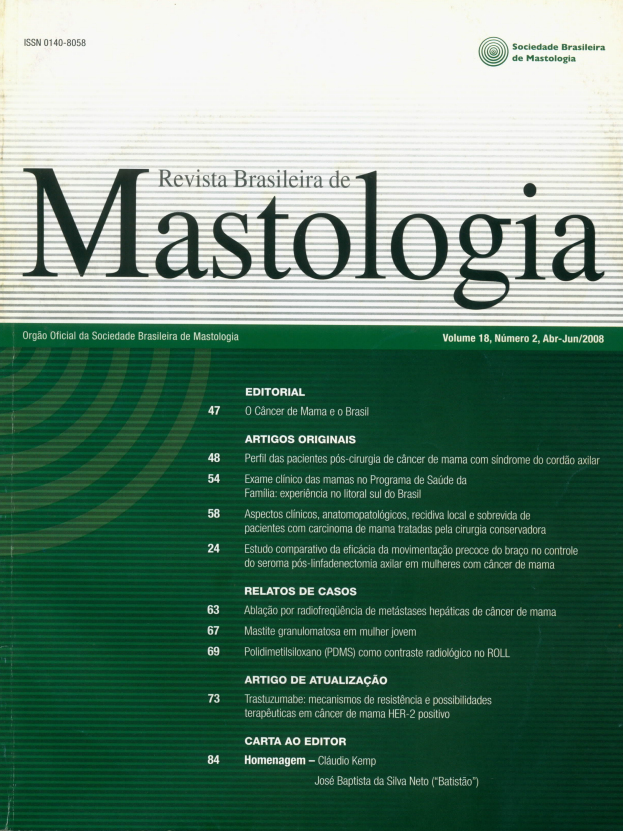
Estudo comparativo da eficácia da movimentação precoce do braço no controle do seroma pós-linfadenectomia axilar em mulheres com câncer de mama
A comparative study of the efficacy of early arm mobilization in the control of seroma formation after axillary limphadenectomy in breast cancer surgery
Keywords:
Breast cancer, Axillary, linfadenectomy, Seroma; Early arm movementAbstract
Objective: To assess the efficacy of early arm movement in the control of seroma formation in women with breast cancer cer submitted to axillary limphadenectomy (AL). Methods: A consecutive and
prospective study of 39 women with the diagnosis of unilateral breast cancer was undertaken. They
were submitted to surgery and had been randomized in two groups: movement group (MG) and
control group (CG). At the first group, patients were oriented to realize early arm movement throught an specific movement training programme that was initiated during hospitalization period and
continued at home; the second group received ordinary orientations. Mann-Whitney and Fisher tests
were used to compare variables between groups. Results: Both groups were homogeneous regarding
age and body mass index (p > 0.05). There were no statistically significant diference between MGand CG about drain permanence time, total drained volume and incidence of seroma. However,
there were a smaller percentage of the number ofseroma punctions (p = 0.01) and punctioned seroma volume (p = 0.04) for MG. Conclusion: Early arm movement favoured a better absorption of
seroma and it was associated with a less invasive resolution ofseroma.
Downloads
References
1. Piatto JRM, Barros ACSD, Ruiz CA, Pinotti M, Ricci MD, Pinotti JA. Conduta cirúrgica em relação aos linfonodos regionais em
mulheres com câncer de mama. Rev Ginec Obst. 2003;14:123-5.
2. Ministério da Saúde. Controle do câncer de mama - Documento
de consenso. Rev Bras Cancerol. 200450:77-90.
3. Bendz I, Olsén MF. Evaluation of immediate versus delayed shoulder exercises after breast cancer surgery including lymph node dissection - a randomized controlled trial. Breast. 2002;11:241-8.
4. Talbot ML, Magarey CJ. Reduced use ofdrainsfollowingaxillary lymphadenectomy for breast cancer. A N ZJ Surg. 2002;72:488-90.
5. Boman L, Lindgren A, Sandelin K. Women's perceptions of seroma and their drainage following mastectomy and axillary lymph
node dissection. Eur J Oncol Nurs. 2002;6(4):231-9.
6. Divino CM, Kuerer HM, Tartter PI. Drains prevent seroma following lumpectomy with axillary dissection. Breast. 2000;6:31-3.
7. Pogson CJ, Adwani A, Ebbs SR. Seroma following breast cancer
surgery. European J Surg Oncol. 2003;29:711-7.
8. Peeters MTFD, Kluit AB, Merkus JWS, Breslau PJ. Short versus
long-term postoperative drainage of the axilla lymph node dissection. A prospective randomized study. Breast Cancer Res Treat.
2005;93:271-5.
9. Stehbens W. Postmastectomy serous drainage and seroma: probable pathogenesis and prevention. AN ZJ Surg. 2003;73:877-80.
10. Soon PSH, Clark CJ, Magarey CJ. Seroma formation after axillary lymphadenectomy with and without the use of drains. Breast.
2003;14:103-7.
11. Woodworth PA, McBoylee MF, Helmer SD, Beamer RL. Seroma
formation after breast cancer surgery: incidence and predicting
factors. Am J Surg. 2000;66(5):444-51.
12. Kopelman L, Klemm O, Bahous H, Klein R, Krausz M, Hashmonai M. Postoperative suction drainage of the axilla: for how long?
Prospective randomized trial. Eur J Surg. 1999;165:117-20.
13. Petrek JA, Peters MM, Nori S, Knauer C, Kinne DW, Rogatko A.
Axillary lymphadenectomy: a prospective, randomized trial of 13
factors influencing drainage, including early or delayed arm mobilization. Arch Surg. 1990;125:378-82.
14. Camargo MC, Marx AG. Reabilitação física no câncer de mama.
São Paulo: Roca; 2000.
15. Shamley DR, Barker K, Simonite V, Beardshaw A. Delayed versus
immediate exercises following surgery for breast cancer: a systematic review. Breast Cancer Res Treat. 2005:90:263-71.
16. Silva MPP, Derchain SFM, Rezende L, Cabello C, Martinez EZ.
Movimento do ombro após cirurgia por carcinoma invasor da
mama: estudo randomizado, prospectivo, controlado de exercícios
livres versus limitados a 90° no pós-operatório. Rev Bras Ginec
Obs. 2004;26:125-30.
17. Rezende LF, Beletti PO, Franco RL, Moraes SS, Gurgel MS. Exercícios livres versus direcionados nas complicações pós-operatórias
de câncer de mama. Rev Assoc Med Bras. 2006:52:37-42.
18. Bonnema J, van Geel AN, Ligtenstein DA, Schmitz PI, Wiggers
T. A prospective randomized trial of high versus low vacuum
drainage after axillary dissection for breast cancer. Am J Surg.
1997;1739:76-9.
19. Morimoto T, Tamura A, Ichihara T, Minakawa T, Kuwamura Y, Miki Y, et al. Evaluation of a new rehabilitation program
for postoperative patients with breast cancer. Nurs Health Sci.
2003:5:275-82.
20. Gonzalez EA, Saltzstein EC, Riedner CS, Nelson BK. Seroma formation following breast cancer surgery. Breast. 2003;9:385-8.
Downloads
Published
How to Cite
Issue
Section
License
Copyright (c) 2026 Thais de Oliveira Gozzo, Ana Maria de Almeida, Marislei Panobianco Sanches, Luiz Gustavo Oliveira Brito, Helio Humberto Angotti Carrara

This work is licensed under a Creative Commons Attribution 4.0 International License.