
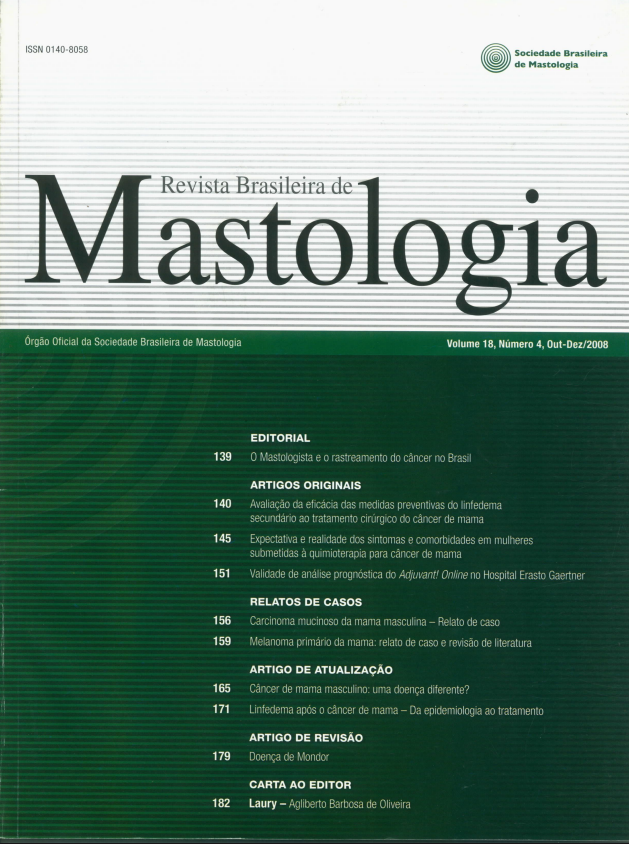
Association of the lymphedema appearance with the acomplishment of the prophylactic measures
Keywords:
Breast cancer, Lymphedema, Prophylactic measuresAbstract
The lymphedema isa quantitative problem between theproduced lymphatic flow and the capacity oftransportation. The risk is associated with to the axillary dissection and armpit radiotherapy, age, number of
dissected lymphonodes and positive ones, level of withdrawal, obesity, extension ofsurgical technique and
infection. prophylactic measures routinely adopted on thepost operation, due to the necessity of information
from these patients. However there's no scientific affirmative, so it's questioned the efficacy of these prevention measures. Objective: It was objectified on this study to analyse the association of the lymphedema
appearance with the accomplishment ofthe prophylactic measures. Methods: There were used 50 women,
that went through the breast cancer surgery at, at least 1 (one) year. The referred patients answered a questionnaire with the purpose of knowing if the prophylactic measures generally oriented in the post operative
as not to go to the manicure, shave or wax the armpit, expose the arm to the sunlight, blood withdrawal,have shots, vaccines, or measure the blood pressure on the surgically treated arm, lift weight, use gloves to
do the dishes, do the laundry and to do yard work, not to injure yourself, or not to burn yourself, not to do
activities with heavy weight, and not to be bitten by bugs were followed. Results/Conclusion: The results
show statistically that the analyzed variables aren't related to the appearance of the lymphedema.
Downloads
References
1. Brasil. Ministério da Saúde. [Inca] Instituto Nacional de Câncer
[on line]. 2007. Disponível em: <http://www.inca.gov.br. Acesso
em: 2 de novembro de 2007.
2. Holmes CE, Muss HB. Diagnosis and treatment of breast cancer
in the eldery. CA Cancer J Clin. 2003;53:227-44.
3. Werner RS, Mccormick B, Petrek J. Arm edema in conservatively
managed breast cancer: obesity is a major predictive factor. Radiology. 1991;180:177-84.
4. Guedes Neto HL. Arm edema after treatment for breast cancer.
Lymphology. 1997;30:35-6.
5. Warren AG, Brorson H, Borud LJ, Slavin SA. Lymphedema:
comprehensive review. Ann Plast Surg. 2007;59:464-72.
6. Bergmann A. Prevalência de linfedema subseqüente a tratamento
cirúrgico para câncer de mama no Rio de Janeiro. Apresentada à
Escola Nacional de Saúde Pública para obtenção do grau de Mestre. Rio de Janeiro; s.n; 2000.
7. Vignes S, Arrault M, Dupuy A. Factors associated with increased breast cancer-related lymphedema volume. Acta Oncol.
2007;11:1-5.
8. Kiel KD, Rademacker AW. Early stage breast cancer: arm edema after
wide excision and breast irradiation. Radiology. 1996;198:279-83.
9. Foldi E, Foldi M, Clodius L. The lymphedema chaos: a lancet. Ann
Plast Surg. 1989;22:505-15.
10. Gashev AA, Zawieja DC. Physiology of human lymphatic contractility: a historical perspective. Lymphology. 2001;34:124-34.
11. Guyton AC. Tratado de fisiologia médica. 8.ed. Rio de Janeiro:
Guanabara Koogan; 1998.
12. Panobianco MS. Acompanhamento dos três primeiros meses póstratamento cirúrgico do câncer de mama: estudo das complicações
e intercorrências associadas ao edema de braço [dissertação]. Ribeirão
Preto (SP): Universidade de São Paulo. Escola de Enfermagem; 1998.
13. Rockson SG. Lymphedema. Am J Med. 2001;110(4):288-95.
14. Harris SR, Hugi MR, Olivotto IA, Levine M, for the Steering
Committee for Clinical Practice Guidelines for the Care and
Treatment of Breast Cancer. Clinical practice guidelines for the
care and treatment of breast cancer: 11. Lymphedema. СAMJ.
2001;164(2):191-9.
15. Meirelles MCCC, Mamede MV, Souza L, Panobianco MS. Evaluation of physiotherapeutic techniques for treating lymphedema following breast cancer surgery in women. Rev Bras Fisioter.
2006:10(4):393-99.
16. Runowicz CD. Lymphedema: patient and provider education.
Cancer. 1998;83(12):2874-6.
17. Erickson VS, Pearson ML, Ganz PA, Adams J, Kahn KL. Arm edema in breast cancer patients. J Natl Cancer Inst. 2001;97(2):96-111.
18. Sociedade Internacional de Linfologia. Consensus Document of
International Society of Lymphology. The diagnosis and treatment
of peripheral lymphedema. Lymphology. 2003;36:84-91.
19. Casley-Smith JR. Measuring and representing peripheral oedema
and its alterations. Lymphology. 1994;27(2):56-70.
20. Bosompra K, Ashikaga T, O'Brien PJ, Nelson L, Skelly J, Beatty
DJ. Knowlegde about preventing and managing lymphedema: a
survey of recently diagnosed and treated breast cancer patients.
Patient Educ Couns. 2002;47(2):155-63.
Downloads
Published
How to Cite
Issue
Section
License
Copyright (c) 2026 Laura Ferreira de Rezende, Hugo Evangelista Brandino, Eduardo Francisco Simon Ciacо

This work is licensed under a Creative Commons Attribution 4.0 International License.