
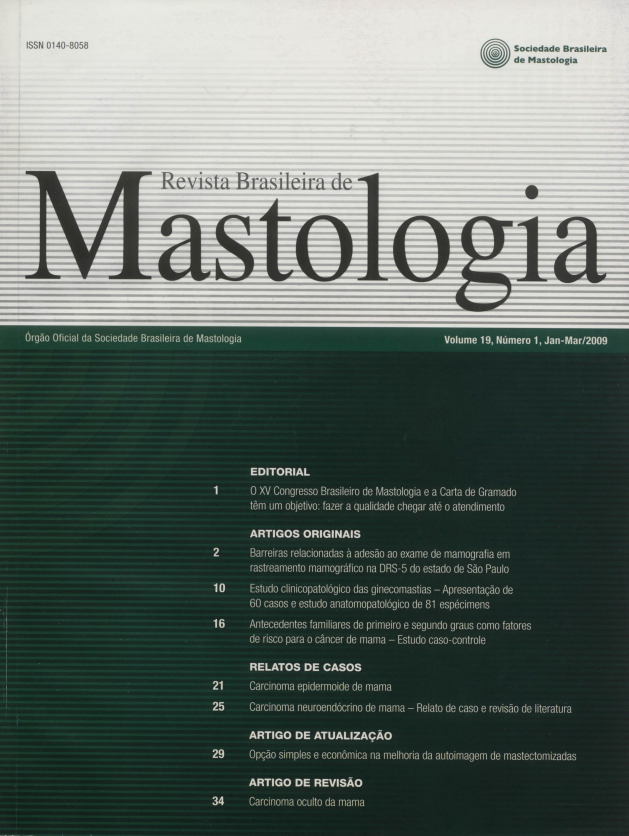
First and second degree family history as a risk factor for breast cancer. A case-control study
Keywords:
Mammary neoplasia, Family history, Risk factorAbstract
Objective: A relevant increase of breast cancer incidence was observed in Brazil in the last few years. An
important risk factor for developing breast cancer is a positivefamily history of this disease. Method: The
knowledge of breast cancer risk factors is a big step towards a meaningful preventive intervention. His is
an epidemiological, retrospective, case-control study, involving institutions listed as reference for cancer
treatment in Alagoas, Brazil during the period between January 2002 and April 2008. Women aged
between 25 and 75years old were included. He sample involved 244 cases with histological confirmation
for breast cancer and 276 controls free of malignant characteristics at mammography (BI-RADS 1 and 2)
or inconclusive mammography (BI-RADS 0) with normal ultrasound and clinical examination. Results:First and second degree family history of breast cancer increased the risk of breast neoplasm in our study
(OR: 2.52; 95% CI: 1.53-4.21; p < 0.01). According to our research, 39% of all woman with family
history of breast cancer present only first degree family history, 57% only present second degree and 4%
present both degrees. An isolated first degree family history increased risk ofthis cancer (OR: 3.81; 95%
Cl: 1.72-9,16; p < 0.01), but isolated second degree history doesn't behave as a risk factor ofthis neoplasm
(OR: 1.89; 95% IC: 1.03-3.51;p = 0.0503). Conclusion: Patient reported of first degree family history
of breast cancer increases the risk of developing disease. Isolated second degree history of breast cancer was
a risk factor for acquire this neoplasm, but was not statistically significant, in our study.
Downloads
References
1. Brasil. Ministério da Saúde. Instituto Nacional do Câncer (Inca).
Controle do Câncer de Mama. Documento de Consenso. Rio de
Janeiro: Inca; 2004.
2. Brasil. Ministério da Saúde. Instituto Nacional de Câncer (Incа).
Estimativas da incidência e mortalidade por câncer no Brasil,
2008. Rio de Janeiro: Inca; 2008.
3. Gonçalves A, Jobim B, Vanacor R, Nunes L, Albuquerque I, Bozzetti M. [Increase in breast cancer mortality in Southern Brazil
from 1980 to 2002]. Cad. Saude Publica. 2007;23(8):1785-90.
4. Zago A, Pereira L, Braga A, Bousquat A. Mortalidade por câncer
de mama em mulheres na Baixada Santista, 1980 a 1999. Rev Saude Publica. 2005;39(4):641-5.
5.
6.
7.
Souza R, Defferrari R, Lazzaron A, Scherer L, Borba A, Frasson
A. Relação da história familiar em primeiro grau com câncer de
mama. Rev Bras Mastol. 1998;8(3):123-8.
Dufloth R, Carvalho S, Heinrich J, Shinzato J, Santos C, Zeferino L, et al. Análise de mutações nos genes BRCA1 e BRCA2 em
pacientes brasileiros com carcinoma de mama e história familiar
positiva. Sao Paulo Med J. 2005;123(4).
Souza R, Lazzaron A, Defferrari R, Álvaro A, Scherer L, Frasson A,
et al. História familiar em segundo grau como fator de risco para
câncer de mama. Rev Bras Ginecol Obstet. 1998;20(8):469-73.
8. Lima GR, Martins NV. Neoplasias malignas da mama. In: Lima
GR, Martins NV (orgs.) Onco ginecologia. Rio de Janeiro: Atheneu; 1992. p. 63-83.
9. Abrão F, et al, editores. Tratado de oncologia genital e mamária.
São Paulo: Roca; 1995.
10. Fletcher S. Screening for breast cancer. Up to date. 2003. Disponível em: http://www.uptodate.com.
11. Veronesi U, et al. Mastologia oncológica. Rio de Janeiro: Medsi;
2002.
12. Bland KI, Copeland III EM. A mama: tratamento compreensivo
das doenças benignas e malignas. São Paulo: Manole; 1994.
13. Stratton J, Gayther S, Russell P, Dearden J, Gore M, Blake P, et
al. Contribution of BRCA-1 mutations to ovarian cancer. N Engl J
Med. 1997;336(16):1125-30.
14. Agullo A. Genética y cáncer de mama. Serviço Cirurgia Hospital
Clínico Valencia; 1999. р. 1-6.
15. Lima S, Piato S, Santos RE, Matheucci E Jr, Monte O. Freqüência
de mutação no códon 12 do gene k-ras no carcinoma ductal invasivo de mama. Rev Bras Ginecol Obstet. 1999;21(3):127-31.
16. Gomes AL, Guimarães MD, Gomes CC, Chaves IG. Gobbi Н.
Camargos AF. A case-control study of risk factors for breast câncer
in Brazil, 1978-1987. Int J Epidemiol. 1995;24(2);292-9.
17. Pinotti JA. Compêndio de mastologia. 4ª ed. São Paulo: Manole;
1991.
18. Armstrong K, Eiren A, Weber B. Assessing the risk of breast cancer. N Engl J Med. 2000;342(8):564-71.
19. Alvares B, Michaell M. O uso da ressonância magnética na investigação do câncer mamário. Radiol Bras. 2003;36(6):373-8.
20. Leal CT, Santos KRRA, Nunesmaia HGS. Características epidemiológicas do câncer de mama no estado da Paraíba. Rev Bras
Mastol. 2002;12(2):15-22.
21. Calderón-Garcidueñas AL, Parás-Barrientos FU, Cárdenas-Ibarra
L, González-Guerrero JF, Villarreal-Ríos E, Staines-Boone T, et
al. Risk factors of breast cancer in Mexican women. Salud Publica
Mex. 2000;42(1):26-33.
22. Thuler LC. Considerações sobre a prevenção do câncer de mama
feminino. Rev Bras Cancerol. 2003;49(4):227-38.
Downloads
Published
How to Cite
Issue
Section
License
Copyright (c) 2026 Marta Maria Vasconcelos de Araújo, Laís Ribeiro da Costa Paes, Thiago Costa de Almeida, Jonatha de Oliveira Lopes, Cira Danielle Casado Alves, Francisca Indira Beltrão Colaço Costa, Andréa Tatiane Oliveira da Silva

This work is licensed under a Creative Commons Attribution 4.0 International License.