
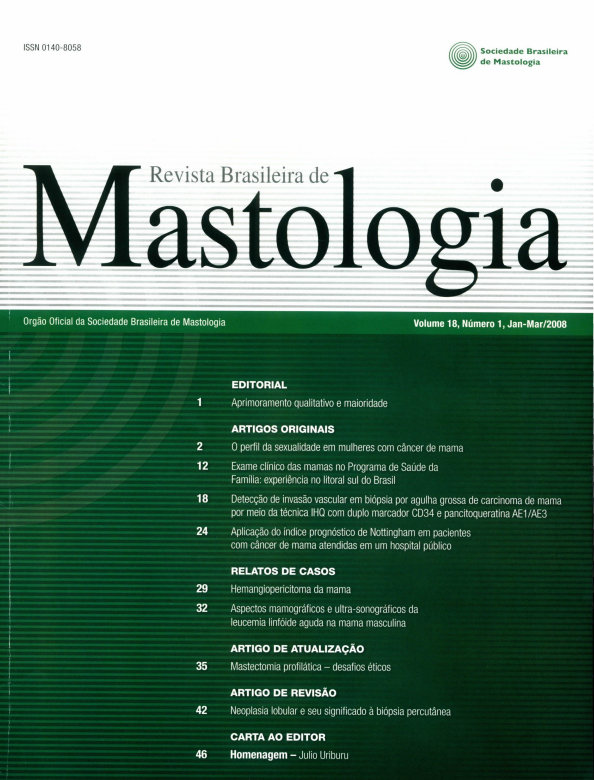
O perfil da sexualidade em mulheres com câncer de mama
The sexual profile of breast cancer women
Palavras-chave:
Neoplasia mamária, Mastectomia radical, Sexualidade feminina, Disfunção sexualResumo
Introdução: O câncer de mama é a neoplasia maligna responsável por cerca de 20% dos óbitos entre as mulheres. Os tratamentos utilizados promovem, de modo geral, alterações na autoimagem, na imagem corporal, no autoconceito e na sexualidade feminina. Assim, objetivou-se
avaliar a presença ou não de disfunções sexuais em mulheres com câncer de mama submetidas à
mastectomia radical. Métodos: Foram avaliadas, pelo período de um ano, 52 mulheres entre 50
e 60 anos de idade, divididas em dois grupos: controle, composto por 37 mulheres com tumores
benignos de mama e 15 submetidas à mastectomia radical, utilizando o Watts Sexual Function
Questionnaire (WSFQ), que avalia os quatro componentes da experiência sexual, incluindo as
percepções sobre desejo sexual, interesse, orgasmo e satisfação, específico para avaliar a sexualidade em sujeitos com patologias clínicas, previamente aplicado na população brasileira¹2. A esse
questionário foram acrescidas questões qualitativas visando a avaliação e a observação das reações
das pacientes diante do diagnóstico cirúrgico e das possíveis alterações advindas da mastectomia
radical na auto-estima, no humor, na capacidade de planejar o futuro e na manutenção do relacionamento afetivo-sexual. Testes estatísticos para medidas repetidas, análise de correlação entre
variáveis e análise exploratória de dados multidimensionais estão entre as técnicas utilizadas para
avaliar o conjunto de dados. Resultados: As principais variações detectadas ao longo do tempo foram: o desejo sexual, no grupo-controle, e a excitação, no grupo submetido à mastectomia radical.
Avaliando-se o impacto do tempo, considerando-se comparativamente os dois grupos, observou-se
piora no desejo das pacientes pertencentes ao grupo-controle comparado ao grupo de mastectomia
radical. Conclusão: A presença de disfunções sexuais em ambos os grupos estavam relacionadas às
mudanças na auto-estima, na auto-imagem, na imagem corporal e no selffeminino.
Downloads
Referências
1. Maluf MFM, Scanavino MT, Barros ACSD. A sexualidade da
mulher submetida a mastectomia radical. Rev Bras Mastol. 2006;
1:27-54.
2. Maluf MFM. A sexualidade das pacientes submetidas à mastectomia radical [monografia de especialização]. São Paulo: Faculdade
de Medicina da Universidade de São Paulo, 2004.
3. Instituto Nacional do Câncer (Inca). Estimativa de incidência de mortalidade por câncer de mama no Brasil (2008). [acesso em 2008 Nov 30]. Disponível em: http://www.inca.gov.br/
estimativa/2008.
4. Maluf MFM, Mori LJ, Barros ACSD. O impacto psicológico do
câncer de mama. Rev Bras Cancerol. 2005;51(2):149-54.
5. Sundquist K, Yee L. Sexuality and body image after cancer. Aust
Fam Physician. 2003;32(1-2):19-23.
6. Watts RJ. Sexual functioning, health beliefs and compliance with
high blood pressure medications. Nurs Res. 1982;31(5):278-83.
7. Abdo CHN, organizadora. Sexualidade humana e seus transtornos. 2ª ed. rev. e ampl. São Paulo: Lemos Editorial; 2000.
8. Associação Psiquiátrica Americana (APA). Manual diagnóstico e estatístico de transtornos mentais (DSM-IV-TR-TM). 4ª ed. Texto revisado. Tradução Cláudia Dornelles. Porto Alegre: Artes Médicas; 2002.
9. Barret-Connor E. Hormone replacement therapy. BMJ. 1998;
317(7156):457-61.
10. Broeckel JA, Thors CL, Jacobsen PB, Small M, Cox CE. Sexual
functioning in long-term cancer survivors treated with adjuvant
chemotherapy. Cancer Res Treat. 2002; 75(3):241-8.
11. Hermann RE, Esselsty CB Jr, Grundefest-Broniatowski S, et al.
Partial mastectomy without radiation is adequate treatment for
patients with stage 0 and 1 carcinoma of the breast. Surg Gynecol
Obstet. 1993;177(3):247-53.
12. Al-Ghazal SK, Sully L, Fallowfield L, Blamey RW. The psychological impact of immediate rather than delayed breast reconstruction. Eur J Surg Oncol. 2000;36(1):17-9.
Rev Bras Mastol. 2008 Jan-Mar;18(1):2-11
13. Al-Ghazal SK, Sully L, Fallowfield L, Blamey RW. Comparison
of psychological aspects and patient satisfaction following breast
conserving surgery, simple mastectomy and breast reconstruction.
Eur J Surg Oncol. 2000;36(15):1938-43.
14. Cohen L, Hack TF, De Moor C, Katz J, Goss PE. The effects of
type of surgery and time on psychological adjustment in women
after breast cancer treatment. Ann Surg Oncol. 2000;7(6):427-34.
15. Dorval M, Maunsell E, Deschênes L, Brisson J. Type of mastectomy and quality of life for long term breast carcinoma survivors.
Cancer. 1998;83(10):2130-8.
16.
17.
Fisher RB, Anderson S, Bryant J, Margolese RG, Deutsch M,
Fisher ER, et al. Twenty year follow-up of a randomized trial
comparing total mastectomy, lumpectomy, and lumpectomy plus
irradiation for the treatment of invasive breast cancer. N Engl J
Med. 2002;347(16):1233-41.
Frischenschlarger O, Balogh B, Predovic M. Psychosocial effects of
plastic surgery reconstruction of the female breast following amputation for malignant/benign tumor. Psychother Psychosom Med
Psychol. 1990;40(11):441-7.
18. Hanson Frost M, Suman VJ, Rummans TA, Dose AM, Taylor M,
Novotny P, et al. Physical, psychological and social well-being of
women with breast cancer: the influence of disease phase. PsychoOncology. 2000;9(3):221-31.
19. Harcourt DM, Rumsey NJ, Ambler NR, Cawthorn SJ, Reid CD,
Maddox PR, et al. The psychological effect of mastectomy with
or without breast reconstruction: a prospective, multicenter study.
Plast Reconstr Surg. 2003;111(3):1060-8.
20. Malata CM, Mcintosh SA, Puruschotham AD. Immediate breast
reconstruction after mastectomy for cancer. Br J Surg 2000; 87(11):
1455-72.
21. Bruner DW, Boyd CP. Assessing women's sexuality after cancer
therapy: checking assumptions with the focus group technique.
Cancer Nurs. 1999;22(6):438-47.
22. Greendale G, Petersen L, Zibecchi L, Ganz PA. Factors related to
sexual function in postmenopausal women with a history of breast
cancer. Menopause. 2001;8(2):111-9.
23. Meyerowitz BE, Desmond KA, Rowland JH, Wyatt GE, Ganz
PA. Sexuality following breast cancer. J Sex Marital Ther.
1999;25(3):237-50.
24. Ganz PA, Schag AC, Lee JJ, Polinsky ML, Tan SJ. Breast conservation
versus mastectomy Is there a difference in psychological adjustment or
quality of life in the year after surgery? Cancer. 1992;69(7):1729-38.
25. Maguire P. Late adverse psychological sequelae of breast cancer
and its treatment. Eur J Surg Oncol. 1999;25(3):317-20.
26. Janni W, Rjosk D, Dimpfl TH, Haertl K, Strobl B, Hepp F, et al.
Quality of life influenced by primary surgical treatment for stage
I-III breast cancer long-term follow-up of a matched-pair analysis.
Ann Surg Oncol. 2001;8(6):542-8.
27. Margolis G, Goodman RL, Rubin A. Psychological effects of breastconserving cancer treatment and mastectomy. Psychosomatics.
1990;31(1):33-9.
28. Oktay JS. Phychological aspects of breast cancer. Lippincotts Prim
Care Pract. 1998;2(2):149-59.
29. Poulsen B, Graversen HP, Beckmann J, Blichert-Toft MA. comparative study of post-operative psychosocial function in women with
primary operable breast cancer randomized to breast conservation
therapy or mastectomy. Eur J Surg Oncol. 1997;23(4):327-34.
30. Pozo C, Carver CS, Noriega V, Harris SD, Robinson DS, Ketcham
AS, et al. Effects of mastectomy versus lumpectomy on emotional
adjustment to breast cancer: a prospective study of the first year
postsurgery. J Clin Oncol. 1992; 10(8):1292-8.31. Rabinowitz B. Understanding and intervening in breast cancer's
emotional and sexual effects. Curr Women's Health Reports.
2002;2(2):140-7.
32. Yilmazer N, Aydiner A, Ozkan S, Asley I, Bilge NA. Comparison
of body image, self-esteem and social support in to total mastectomy and breast-conserving therapy in Turkish women. Support
Care Cancer. 1994;2(4):238-41.
33. Urbánek V, Weiss P, Kofránek J, Albl M. Psychosexual reactions
in women after treatment of breast carcinoma. Ceska Gynekol.
1994a:59(5):262-4.
34. Van't Spijker A, Trijburg RW, Duivenvoorden HJ. Psychological
sequelae of cancer diagnosis: a meta-analytical review of 58 studies
after 1980. Psychossom Med. 1997;59(3):280-93.
35. Moyer A. Psychological outcomes of breast conserving surgery
versus mastectomy: a meta-analytic review. Health Psychol. 1997:16(3):284-98.
36. Bukovic D, Fajdic J, Stricnic T, Habec M, Hojsak I, Radakovic N.
Differences in sexual functioning between patients with benign and
malignant breast tumors. Coll Antropol. 2004; 28 Suppl 2:191-201.
37. Chessear ES, Anderson JL. Treatment of breast cancer: doctor/patient communication and psychological implications. Proc R Soc
Med. 1975;68(12):793-5.
38. Carrasco MJ. Disfunciones sexuales femeninas. Madri: Editorial
Síntesis: 2001.
39. Kaplan HS. Transtornos do desejo sexual: regulação disfuncional
da motivação sexual. Tradução Jussara N. Burnier. Porto Alegre:
Artes Médicas; 1999.
40. Chwałczyńska A, Woźniewski M, Rozek-Mróz K, Malicka I. Quality of life in women after mastectomy. Wiad Lek. 2004;57(5-6):
212-6.
41. Vos P, Garssen B, Visser AP, Duivenvoorden HJ, Haes da HCJ.
Early stage breast cancer: explaining level of psychosocial adjustment using structural equation modeling. J Behav Med.
2004;27(6):557-80.
42. Maluf MFM. O luto no câncer de mama. In: Piato S, Piato JRM.
Doenças da mama. Rio de Janeiro: Revinter; 2005, p. 235-9.
43. Takahashi M, Kai I. Sexuality after breast cancer treatment: changes
and coping strategies among. Soc Sci Med. 2007;61(6): 1278-90.
44. Wilmoth MC, Townsend JA. A comparison of the effects of
lumpectomy versus mastectomy on sexual behaviours. Cancer
Pract. 1995;3(5):279-85.
45. Nissen MJ, Swenson KK, Ritz LJ, Farrell JB, Sladek ML, Lally
RM. Quality of life after breast carcinoma surgery: a comparison
of three surgical procedures. Cancer. 2001;91(7):1238-46.
46. Fallowfield LJ. Psychosocial adjustment after treatment for early
breast cancer. Oncology (Huntingt). 1990;4(4):87-97.
Downloads
Publicado
Como Citar
Edição
Seção
Licença
Copyright (c) 2026 Maria Fernanda de Matos Maluf, Marco de Tubino Scanavino, Alfredo Carlos S. D. Barros, Lincon Jo Mori, Fabrício Saad Duarte, Elsa Aida Gay

Este trabalho está licenciado sob uma licença Creative Commons Attribution 4.0 International License.