
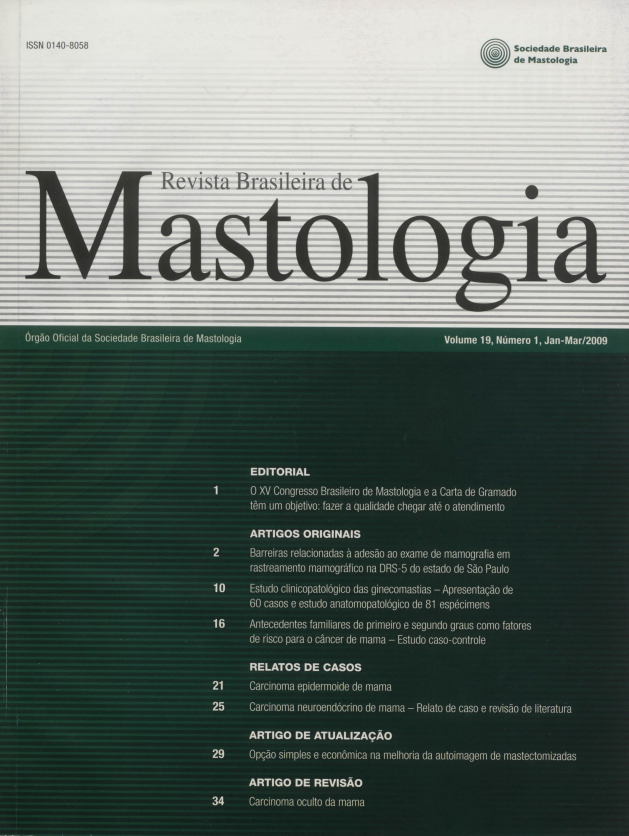
Barriers related to the non-adherence to the mammography screening program in DRS-5 of the state of São Paulo
Keywords:
Breast cancer, Mammography, Screening, Health planning, Adherence for screeningAbstract
Introduction: Mammography is the best method to reduce the mortality from breast cancer, related to
increase in early diagnosis. There are barriers related to low adherence to mammography, and the main
reasons are related to health system, education and adherence to guidelines. In 2003 began in DRS-5
mammography screening controlling the factors related to health system and knowledge. Objective:
When we done mammography in 50.3% of DRS-5 women, wefind the characteristics of women that although having the knowledge ofbreast screening hadn't done mammographyyet. Methods: We interview
550 women from 19 cities with questions related to the knowledge about breast clinical examination orreasons related to non adherence to mammography, and the strategy used to find these women. Results:
The women had low years of school (84.7%), low income (66.8%) and were 42-49 years old (43.8%).
The clinical frequently doesn't realize breast examination (14.9%), and low women know how to do
this exam (25.8%). Besides the clinical doesn't inform about the importance of mammography (23.6%),
women don't realize this exam because the absent of health symptoms (60.4%), afraid of pain (25.1%)
or afraid ofcancer (20.5%). The "Programa de Saúde da Familia” (PSF) had a fundamental importance to identify these women (90.0%), and just 71.8% ofthe interview women realize mammography.
Conclusions: The identification ofsub-group non adherent to mammography screening shows us the
importance to improve the screening, and the PSFis a good way to promote heath intervention.
Downloads
References
1. Brasil. Ministério da Saúde. Instituto Nacional de Câncer - INCA.
A situação do câncer no Brasil [acesso em 2008 dez 7]. Disponível
em: http://www.inca.gov.br/situacao/.
2. Parkin DM, Bray F, Ferlay J, Pisani P. Global cancer statistics,
2002. CA Cancer J Clin. 2005;55(2):74-108.
3. Jemal A, Siegel R, Ward E, Hao Y, Xu J, Murray T, Thun NJ. Cancer statistics, 2008. CA Cancer J Clin. 2008;58(2):71-96.
4. Schwartsmann, G. Breast cancer in South America: challenges to
improve early detection and medical management of a public health problem. J Clin Oncol. 2001;19(18 Suppl):118S-24.
5. Monteiro APS, Arraes EPP, Pontes LB, Capôs MSS, Ribeiro RT,
Gonçalves REB. Auto-exame das mamas: freqüência do conhecimento, prática e fatores associados. Rev Bras Ginecol Obst. 2003;
25(3):201-5.
6. Xavier NL, Riberiro PLI, Menke CH, Cavalheiro JAC, Xavier MC.
Exame clínico das mamas no Programa de Saúde da Família: experiência no litoral sul do Brasil. Rev Bras Mastol. 2008;18(1):12-7.
7. Kemp C, Petti DA, Ferraro O, Elias J. Câncer de mama - Prevenção
secundária. Projeto diretrizes. Sociedade Brasileira de Mastologia,
Federação Brasileira das Sociedades de Ginecologia e Obstetrícia,
Associação Médica Brasileira e Conselho Federal de Medicina. 2002
Ago 22 [acesso em 2008 Dec 7]; [9 p.]. Disponível em: http://www.
projetodiretrizes.org.br/projeto_diretrizes/026.pdf.
8. Thuler LC. Considerações sobre a prevenção do câncer de mama
feminino. Rev Bras Cancerol. 2003(4);49:227-38.
9. Verbeek AL, Hendriks JH, Holland R, Marvunac M, Sturmans F,
Day NE, et al. Screening and breast cancer. Lancet. 1984; 22;
2(8404):690.
10. Lee CH. Screening mammography: proven benefit, continued
controversy. Radiol Clin North Am. 2002,40(3):395-407.
11. Shapiro S. Screening: assessment of current studies. Cancer. 1994;
74(1 Suppl):231-8.
12. Kerlikowske K. Efficacy of screening mammography among women aged 40 to 49 years and 50 to 69 years: comparison of relative
and absolute benefit. J Nath Cancer Inst Monogr. 1997;22:79-86.
13. Gebrim LH, Quadros LG. Rastreamento mamográfico no Brasil.
RBGO. Rev Brasil Ginecol Obst. 2006;28(3):319-23.
14. Brasil. Ministério de Planejamento, Orçamento e Gestão. Instituto
Brasileiro de Geografia e Estatística. Pesquisa nacional por amostra de
domicílios: acesso e utilização dos serviços de saúde 2003 [acesso em
2007 Jan 15]. Disponível em: http://www.ibge.com.br/home/estatistica/populacao/trabalhoerendimento/pnad2003/saude/default.shtm.
15. Reintgen DS, Clark RA, editores. Cancer Screening. St Loius: Mosby; 1994. Chapter 12, Adherence to cancer screening. р. 261-76.
16. Womeodu RJ, Bailey JE. Barriers to cancer screening. Med Clin
North Am. 1996;80(1):115-33.
17. Legler J, Meissner HI, Coyne C, Breen N, Chollette V, Rimer ВК.
The effectiveness of interventions to mammography among women
with historically lower rates of screening. Cancer Epidemiol Biomarkers Prev. 2002;11(1):59-71.
18. Godinho ER, Koch HA. Rastreamento do câncer de mama: aspectos relacionados ao médico. Radiol Bras. 2004;37(2):91-9.
19. Anderson BO, Jakesz R. Breast cancer issues in developing countries: an overview of the Breast Health Global Initiative. World J
Surg. 2008;32(12):2578-85.
20. Godinho ER, Kock HA. O perfil da mulher que se submete à mamografia em Goiânia. Uma contribuição a bases para um programa de detecção precoce do câncer de mama. Radiol Bras. 2002;
35(3):139-45.
21. Aro RA, de Koning HK, Absetz P, Schreck M. Two distint groups
of non-attenders in an organized mammography screening program. Breast Cancer Res Treat. 2001;70(2):145-53.
22. Lagerlund M, Maxwell AE, Bastani R, Thurfiell E, Ekbom A,
Lambe M. Sociodemographic predictors of non-attendance at invitational mammography screening-a population-based register
study (Sweden). Cancer Causes Control. 2002;13(1):73-82.
23. Ward E, Jemal A, Cokkinides V, Singh GK, Cardineaz C,
Ghafoor A, Thun M. Cancer disparities by race/ethnicity and socioeconomic status. CA Cancer J Clin. 2004;54(2):78-93.
24. Rubenstein L. Strategies to overcome barriers to early detection of
cancer ammong older adults. Cancer. 1994;74(7 Suppl):2190-3.
25. Kelaher M, Stellman JM. The impact of medical funding on the
use of mammography among older women: implications for improving acess to screening. Prev Med. 2000;31(6):658-64.
26. Young RF, Severson RK. Breast cancer screening barriers and
mammography completion in older minority women. Breast Cancer Res Treat. 2005;89(2):111-8.
27.
ARTIGO ORIGINAL
Barreiras relacionadas à adesão ao exame de mamografia em rastreamento
mamográfico na DRS-5 do estado de São Paulo
Lourenço TS et al.
Bakemeier RF, Krebs LU, Murphy JR, Shen Z, Ryals T. Attitudes
of Colorado health professionals toward breast and cervical cancer
screening in Hispanic women. J Nath Cancer Inst Monogr. 1995;
18:95-100.
28. Lagerlund M, Hedin A, Sparen P, Thurfiell E, Lambe M. Attitudes, beliefs and knoledge as predictors of nonattendance in a Swedish population-based mammography screening program. Prev
Med. 2000;31(4):417-28.
29. Burnett CV, Steakley CS, Tefft MC. Barriers to breast and cervical
cancer screening in underserved women of the District of Columbia. Oncol Nurs Forum. 1995;22(10):1551-7.
30. Molina L, De Luca LA. Análise das oportunidades de diagnóstico precoce para as neoplasias malignas da mama. Rev Assoc Med
Bras. 2003;49(2):185-90.
Downloads
Published
How to Cite
Issue
Section
License
Copyright (c) 2026 Tânia Silveira Lourenço, René Aloísio da Costa Vieira, Edmundo Carvalho Mauad, Thiago Buosi Silva, Allini Mafra da Costa, Stela Vervinhasse Peres

This work is licensed under a Creative Commons Attribution 4.0 International License.