
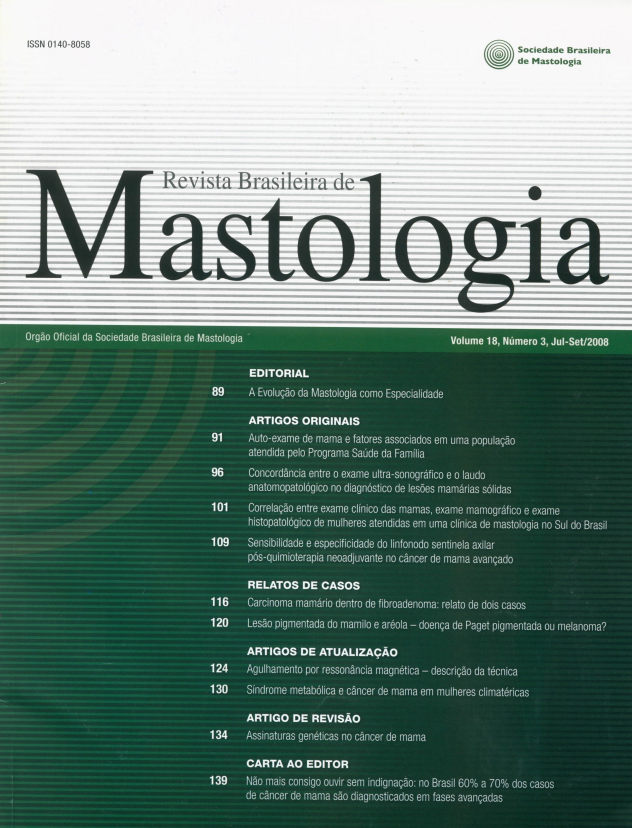
Breast self exam and correlation with associated factors in population of Health Family Program
Keywords:
Precous diagnosis, Prevalence breast self examination, Sociodemographic factorsAbstract
Objectives: In order to evaluate the knowledge and the practice ofthe breast self examination (BSE)
in a low income population from the north shore of the estate of Rio Grande do Sul, as well to report
the prevalence and sociodemographicfactors associations. Methods: Public health employees from the
Health Family Program invited women over 20 years of age for a breast clinical examination at a community clinic. They were submitted to semi-structured questionnaire aboutfactors potentially associated
to the knowledge and practice of BSE. Current age, marital status, education level, family income andbreast cancer history of close relatives were collected and reported. Results: 728 women were included
in the study. About 97% of women had knowledge ofthe BSE and 82,1% of them referred a regular
practice. Among the 592 that referred the practice of BSE, only 207 (28% of the sample) did it monthly.
The variables that were statistically associated with monthly BSE were: current age (p < 0.001) and
educational level (p < 0.02). Marital status,family income and breast cancer history ofclose relatives did
not generated statistical significant values. Conclusion: The practice and frequency ofthe BSE was inadequate in the study population although most of them reported knowing BSE, only 28% use to perform
it correctly. Women with higher educational level and old age were more adherent to the BSE practice.
Downloads
References
1. Marinho LAB, Costa-Gurgel MS, Cecatti JG, et al. Conhecimento, atitude e prática do auto-exame das mamas em centros de saúde. Rev. Saude Publica. 2003;37(5):576-82.
2. Devine SK, Frank DI. Nurses performing and teaching others breast self-examinations: implications for advanced practice nurses.
Clin Excell Nurse Pract. 2000;4:216-23.
3.
4.
Thomas DB, Gao DL, Ray RM, et al. Randomized trial of breast
self-examination in Shanghai: final results. J Natl Cancer Inst.
2002;94:1445-7.
Hackshaw AK, Paul EA. Breast self-examination and death from
breast cancer: a meta-analysis. Br J Cancer. 2003;88:1047-53.
5. McPherson CP, Swenson KK, Jolitz G, Murray CL. Survival of
women ages 40-49 years with breast carcinoma according to method of detection. Cancer. 1997:79:1923-32.
6. Koibuchi Y, Iino Y, Takei H, Maemura M, Horiguchi J, Yokoe T, et
al. The effect of mass screening by physical examination combined
with regular breast self-examination on clinical stage and course of
Japanese women with breast cancer. Oncol Rep. 1998;5:151-5.
7. Gastrin G, Miller AB, To T, Aronson KJ, Wall C, Hakama M,
et al. Incidence and mortality from breast cancer in the Mama
Program for Breast Screening in Finland, 1973-1986. Cancer.
1994;73:2168-74.
8. Acesso em 2008 May 28. Disponível em: http://www.ibge.gov.br/
home/estatistica/populacao/condicaodevida/pdf/2002analise/ta- b8607e.pdf.
9. The five steps of breast self exam. Disponível em: http://www.
breastcancer.org/symptons/testing/self_exam/bse_steps.jsp.
10. Monteiro APS, Arraes EPP, Pontes LB, Campos MSS, Ribeiro
RT, Gonçalves REB. Auto-exame das mamas: freqüência do conhecimento, prática e fatores associados. Rev Bras Ginecol Obstet.
2003;25;201-5.
11. Freitas Jr. R, Soares VF, Melo NF, Andrade ML, Philocréon GR.
Fatores determinantes do conhecimento e prática do auto-exame
de mama. Rev Bras Ginecol Obstet. 1996;18:387-91.
12. Sclowitz ML, Menezes AMB, Gigante DP, Tessaro S. Condutas na
prevenção secundária do câncer de mama e fatores associados. Rev
Saude Publica. 2005:39.
13. Costa JSD, Piccini RX, Moreira MR. Avaliação da prática do autoexame e exame físico de mamas na cidade de Pelotas, RS. Rev Bras
Ginecol Obstet. 1995;17:621-30.
14. Molina L, Dalben I, de Luca LA. An analyze the opportunity of early
detection of breast cancer. Rev Assoc Med Bras. 2003;49(2):185-90.
15. Petro-Nustus W, Mikhail BI. Factors tor associated with breast
self-examination among jordanian women. Public Health Nurs.
2002;19:263-71.
16. Yavari P, Pourhoseingholi MA. Socioeconomic factors association with knowledge and practice of breast self-examination
among Iranian women. Asian Pac J Cancer Prev. 2007 OctDec;8(4):618-22.
17. Michielutte R, Dignan MB, Smith BL. Psychosocial factors associated with the use of breast cancer screening by women age 60
years or over. Health Educ Behav. 1999;26(5):625-47.
18. Antill YC, Reynolds J, Young MA, Kirk JA, Tucker KM, Bogtstra
TL, et al. Screening behavior in women at increased familial risk
for breast cancer. Fam Cancer. 2006;5(4):359-68.
19. Hegarty V, Burchett BM, Gold DT, Cohen HJ. Racial differences
in use of cancer prevention services among older Americans. J Am
Geriatr Soc. 2000;48:735-40.
20. Del Giudice ME, Tannenbaum D, Goodwin PJ. Breast self-examination: resistance to change. Can Fam Physician. 2005;51:698-9.
Downloads
Published
How to Cite
Issue
Section
License
Copyright (c) 2026 Nilton Leite Xavier, Jorge Villanova Biazús, Miguel da Cunha Xavier, Patrícia Lisboa Izetti Ribeiro, Ana Cristina Costa Bittelbrunn, Eliane Goldemberg Rabin

This work is licensed under a Creative Commons Attribution 4.0 International License.